AI estimate as of August 10, 2025 · verify with a professional before acting
AI-Generated · Verify before acting
Everything on this page is generated by AI for informational purposes only. AI can make mistakes — the AI may misidentify items or misattribute them (artist, maker, brand, designer, origin, era). This is not an official valuation and should not be used for insurance, sale, tax, estate, legal, or lending purposes — or any decision requiring a certified appraisal. It is not an authoritative claim about any person, brand, or rights holder — do not share or rely on it as a factual statement about a third party. Always consult qualified professionals before making financial decisions.
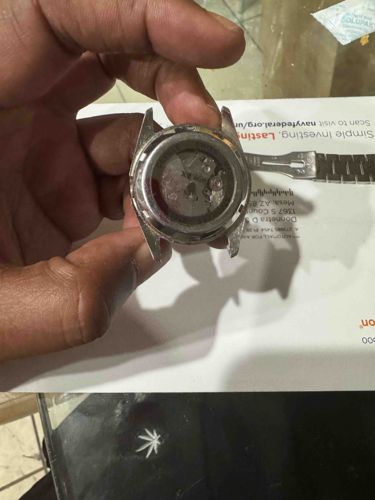
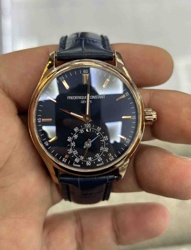
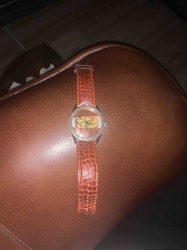
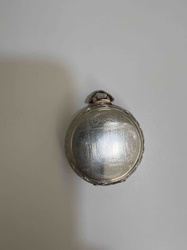
The item is a vintage mechanical watch movement and partial watch case, likely for a men's wristwatch. The case appears to be constructed from a base metal, possibly chrome-plated or stainless steel, exhibiting significant signs of wear, including scratches, discoloration, and what appears to be corrosion or oxidation around the edges and lugs. The case, held in a person's hand, is viewed from the back, showing the exposed mechanical movement. The movement itself is an automatic winding mechanism, as indicated by the presence of a rotor visible through the open case back. Several gears and levers characteristic of a mechanical watch movement are discernible. There are visible screws and plates, some of which show signs of patina or light corrosion. The balance wheel, escapement, and mainspring barrel are not clearly visible due to the angle and lighting, but the overall complexity suggests a multi-jeweled movement. The construction appears utilitarian rather than finely finished, consistent with a mass-produced watch from the mid-20th century. The absence of the crystal, dial, hands, and the full case back indicates that the item is incomplete or disassembled. There are no clear maker's marks or distinguishing engravings visible on the movement or case from this angle. The detached metal bracelet, visible to the right of the watch case, is a folded link type, typical of older, more economical watch bands, and shows wear and tarnishing. The condition of the internal components (movement) cannot be fully assessed without closer inspection, but externally, the components show age and grime. The overall impression is that of a used, possibly non-functional, vintage watch in need of repair or restoration.
AI Appraisal Report
I have examined the provided image of the vintage mechanical watch movement and partial case. The item appears to be a mid-20th century automatic winding movement within a heavily worn, likely base metal wristwatch case. The visible rotor confirms it as an automatic. The absence of crystal, dial, hands, and a full case back indicates it's incomplete or disassembled. The condition of the case is poor, showing significant scratches, discoloration, and corrosion, consistent with utilitarian base metal construction. The detached folded link bracelet further suggests a mass-produced, economical timepiece.
Authenticity cannot be fully verified from images alone, particularly without discernable maker's marks or movement engravings. The visible components appear consistent with period mass-produced movements, not high-end horology. Without an in-person examination to assess the internal movement's functionality, integrity, jewel count, and precise caliber, I cannot definitively determine its operational status or specific manufacturer. Provenance documentation would also aid in identification.
Market demand for incomplete, non-functional, or heavily damaged vintage watches like this is generally low, unless it's a rare or historically significant manufacturer/model, which is not evident here. Comparables would include 'parts movements' or 'project watches' of common vintage calibers. The primary value lies in its potential for parts or as a restoration project, but the extent of damage makes it a challenging endeavor. The lack of identifiable features limits rarity considerations.
Factors significantly impacting value negatively are the incomplete state, severe case wear, unknown functionality, and lack of clear identity. Positive factors are absent from this visual examination.
For full authentication and a more precise valuation, an in-hand inspection is critical to verify the movement's caliber, jewel count, condition of internal components, and to check for hidden marks. Scientific testing for case material composition could also be beneficial.