These notes were written by the person who submitted this item. Appraiser.AI has not verified them, and the AI's identification and estimate may rely on them.
AI Estimated Value
Not an official valuation
$400-700
AI estimate as of August 8, 2025 · verify with a professional before acting
AI-Generated · Verify before acting
Everything on this page is generated by AI for informational purposes only. AI can make mistakes — the AI may misidentify items or misattribute them (artist, maker, brand, designer, origin, era). This is not an official valuation and should not be used for insurance, sale, tax, estate, legal, or lending purposes — or any decision requiring a certified appraisal. It is not an authoritative claim about any person, brand, or rights holder — do not share or rely on it as a factual statement about a third party. Always consult qualified professionals before making financial decisions.
This analysis also relies on unverified notes provided by the user, which may be incomplete or inaccurate and could affect the result.
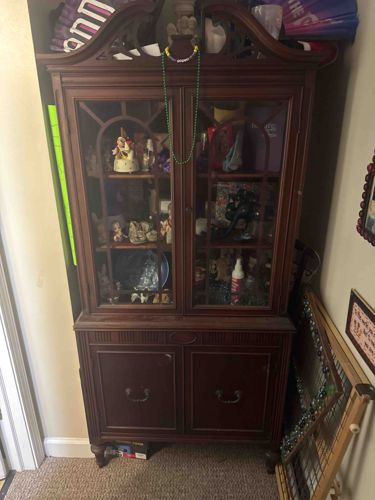
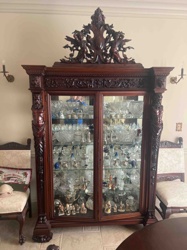
This is a substantial wooden hutch cabinet, likely constructed from a dark-stained hardwood, possibly mahogany or cherry, given its rich, deep brown hue. The piece exhibits characteristics of traditional or transitional furniture design, possibly dating from the late 20th century to early 21st century. It stands as a single, tall unit, comprising an upper display section with glass doors and a lower storage cabinet with solid doors. The upper section features two glass-paned doors, each with an arched top and decorative muntins forming an attractive, possibly Queen Anne-style, pattern in the upper corners. The glass appears clear, allowing visibility of the items stored within. Above the glass doors, the cabinet is adorned with an ornate, carved pediment or crown molding featuring scrolled elements and a central finial or decorative accent, adding to its formal appearance. The middle section, separating the upper and lower halves, includes what appears to be a drawer or a decorative frieze with fluted or reeded detailing, suggesting fine craftsmanship. The lower section consists of two solid wood doors with raised panels and brass-colored, bail-pull handles, indicating enclosed storage space. The cabinet rests on short, possibly bun or spade-style, feet, consistent with its overall traditional aesthetic. Visible condition includes some dust accumulation, particularly on the lower shelves and around the base, and minor surface wear commensurate with use, but no overt damage like cracks or significant scratches are immediately apparent. The finish appears largely intact with a visible sheen. The robust construction and decorative elements suggest a commercially produced piece designed for display and storage in a dining room or living area.
AI Appraisal Report
This Traditional Dark Wood Display Hutch Cabinet, likely late 20th to early 21st century, is a functional and decorative piece. Based on visual examination, the condition appears good, with expected minor surface wear and dust accumulation consistent with age and use, but no significant damage is evident. Its construction, including the detailed pediment, arched glass doors with muntins, and raised paneling, points to a commercially produced item. While the dark stain suggests mahogany or cherry, definitive wood type and authentication of materials cannot be confirmed without in-person examination. Likewise, the exact age cannot be precisely determined from images alone; maker's marks or joinery analysis would be required.
The market for traditional display cabinets has seen some fluctuation. While large, dark wood pieces are not as universally sought after as they once were, there remains a steady demand for well-maintained examples for traditional or transitional interiors. Comparables for similar commercially produced hutches in good condition typically range from $300 to $800, depending heavily on regional market demand, brand, and actual wood species. This piece's ornate detailing adds some visual appeal, which could marginally increase its desirability. Rarirty is low as these were mass-produced. Factors impacting value include its robust construction and decorative elements. Without physical inspection, I cannot verify the integrity of the joinery, drawer slide functionality, or presence of any hidden damages or repairs. Provenance documentation, if available, could confirm manufacturer and age, potentially impacting value.