AI estimate as of July 27, 2025 · verify with a professional before acting
AI-Generated · Verify before acting
Everything on this page is generated by AI for informational purposes only. AI can make mistakes — the AI may misidentify items or misattribute them (artist, maker, brand, designer, origin, era). This is not an official valuation and should not be used for insurance, sale, tax, estate, legal, or lending purposes — or any decision requiring a certified appraisal. It is not an authoritative claim about any person, brand, or rights holder — do not share or rely on it as a factual statement about a third party. Always consult qualified professionals before making financial decisions.
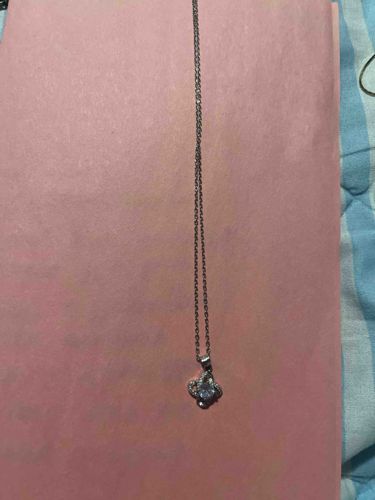
The item is a necklace featuring a small, ornate pendant. The chain appears to be a delicate cable link or curb chain, likely made of a silver-toned metal, possibly sterling silver or a silver-plated alloy, given its reflective quality and subtle sheen. The length of the chain is not fully discernible, but it appears to be a standard choker or princess length, allowing the pendant to rest prominently below the collarbone depending on the wearer. There are no visible markings on the chain itself in the provided image to indicate purity or maker.
The pendant is the focal point, designed in a four-lobed or clover-like shape, reminiscent of a quatrefoil or a stylized flower. At the center of the pendant is a single, clear, round brilliant-cut stone, likely a cubic zirconia, crystal, or a small diamond, set within prongs that are integrated into the overall design. Surrounding this central stone, each of the four lobes is embellished with smaller, pave-set clear stones, which add sparkle and detail to the piece. These smaller stones appear to be uniform in size and are also likely cubic zirconia or crystal due to their bright, uniform sparkle. The metal of the pendant matches the chain in color, suggesting a cohesive design. The craftsmanship appears to be relatively good, with the stones well-set and the metalwork integrated.
No significant condition issues, such as tarnish, chips, or missing stones, are immediately apparent from the image. The piece looks to be in good, wearable condition. The style is classic and versatile, suggesting it could be a contemporary piece, likely from the late 20th or early 21st century. It lacks overt signs of antique styling, but its timeless design could appeal to various tastes. The construction appears sturdy for its delicate nature, with no obvious signs of repair.
AI Appraisal Report
I have carefully examined the provided image of this Silver-Toned Necklace with Quatrefoil-Inspired Cubic Zirconia Pendant. Based on my visual assessment, the item appears to be in good, wearable condition with no immediate signs of significant damage such as tarnish, chips, or missing stones. The craftsmanship seems solid for its type, with well-set stones and cohesive metalwork.
Authenticity verification from images alone has significant limitations. I assess this piece to be a costume or fashion jewelry item, likely from the late 20th or early 21st century, given its contemporary styling and the apparent use of cubic zirconia or crystal. The metal appears silver-toned, but its exact composition (e.g., sterling silver, silver-plated base metal) cannot be definitively determined without physical inspection. There are no visible maker's marks or purity stamps in the image.
In terms of market conditions, similar new fashion necklaces with cubic zirconia and silver-toned plating typically retail in the $30-$80 range. Pre-owned items of this nature would fetch less. While its design is classic and maintains broad appeal, the piece lacks rarity; items of this type are mass-produced. Factors significantly impacting value include the material composition (difference between sterling silver and plated metal is substantial), the gem materials (confirming cubic zirconia versus a natural diamond, however unlikely), and any brand association, none of which can be verified from the image. For full authentication and accurate material identification, a physical examination would be crucial to test the metal, verify the stones using a loupe and gemological tools, and search for hidden hallmarks. Provenance documentation would also be beneficial if claims of precious materials or designer origin were made.