AI estimate as of July 17, 2025 · verify with a professional before acting
AI-Generated · Verify before acting
Everything on this page is generated by AI for informational purposes only. AI can make mistakes — the AI may misidentify items or misattribute them (artist, maker, brand, designer, origin, era). This is not an official valuation and should not be used for insurance, sale, tax, estate, legal, or lending purposes — or any decision requiring a certified appraisal. It is not an authoritative claim about any person, brand, or rights holder — do not share or rely on it as a factual statement about a third party. Always consult qualified professionals before making financial decisions.
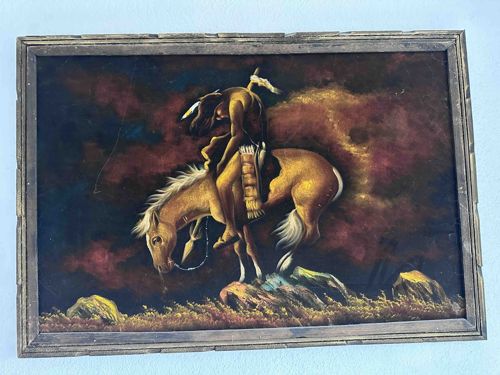
This item is a framed velvet painting depicting a Native American rider on a horse. The painting's dimensions, visually estimated, are typical of popular art pieces from the mid to late 20th century, likely around 18x24 inches to 24x36 inches. It is executed on black velvet, a common medium for a specific style of art, often associated with souvenir or mass-produced decorative pieces from the 1960s to 1980s. The color palette predominantly features warm tones: the horse is a golden-tan or light brown with a white mane and tail, while the rider's skin tone is warm brown. The background consists of dark blues and blacks, with swathes of reddish-brown and orange that evoke a dramatic or fiery sky, possibly a sunset or sunrise, or even stylized clouds. The ground is rendered in earthy tones of brown and green/gold with highlights to suggest rocky, sparse terrain. The horse is depicted with its head lowered, a bridle visible, and one front leg slightly raised, standing on what appears to be a rock. The rider is hunched over, seemingly in a pose of contemplation or weariness. A feather is visible in the rider's hair or headdress, and visible tassels or fringes hang from the saddle area. The artwork has visible condition issues, notably a long, diagonal scratch or tear across the upper left quadrant of the velvet surface, indicating damage to the fabric. There are no discernible maker's marks, signatures, or stamps evident in the provided image; such pieces were often produced by anonymous or commercial artists. The frame is a simple, rustic-style wooden frame, likely stained or painted dark brown, showing some signs of wear and age, consistent with the estimated period of the painting. The craftsmanship is typical of decorative art rather than fine art, with bold brushstrokes and a focus on color and form to create a striking visual.
AI Appraisal Report
Upon visual examination, this item is a framed velvet painting depicting a Native American rider on horseback, a popular decorative art form from the mid-to-late 20th century, likely the 1960s to 1980s. These pieces were often mass-produced as souvenirs or decorative items and are not typically considered fine art. The painting is unsigned, which is common for this genre and suggests production by a commercial or anonymous artist.
The most significant factor impacting value is the item's condition. There is a prominent diagonal scratch or tear across the upper left quadrant of the velvet. This damage is substantial and severely detracts from the painting's aesthetic appeal and marketability. The frame appears to be original and shows age-appropriate wear.
The market for such velvet paintings is generally soft, driven by nostalgia and decorative appeal rather than artistic merit or rarity. Comparable unsigned velvet paintings in good condition typically sell for modest sums. However, the visible damage on this particular piece places it at the lowest end of the value spectrum, primarily as a decorative object with 'for parts' or 'as-is' value.
While the imagery is standard for its type, authenticity confirmation is limited. A physical inspection would allow for closer examination of the materials (velvet, paint, frame) to confirm the period and rule out a modern reproduction. However, given the nature and condition of the item, extensive authentication efforts would not be cost-effective.