AI estimate as of July 14, 2025 · verify with a professional before acting
AI-Generated · Verify before acting
Everything on this page is generated by AI for informational purposes only. AI can make mistakes — the AI may misidentify items or misattribute them (artist, maker, brand, designer, origin, era). This is not an official valuation and should not be used for insurance, sale, tax, estate, legal, or lending purposes — or any decision requiring a certified appraisal. It is not an authoritative claim about any person, brand, or rights holder — do not share or rely on it as a factual statement about a third party. Always consult qualified professionals before making financial decisions.
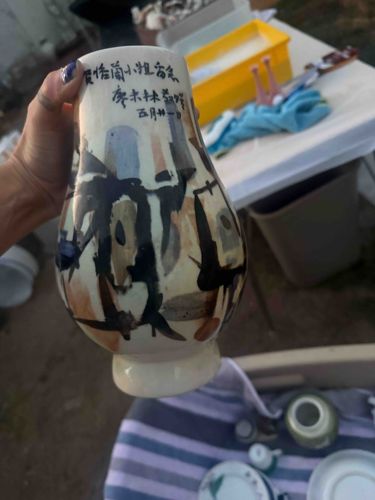
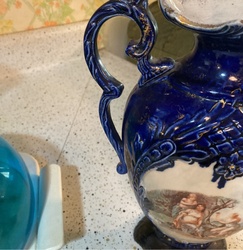
This is a ceramic vase, likely made of stoneware or porcelain given its smooth, glazed surface. The vase has an ovoid body, wider at the shoulder and tapering towards a narrower base, which rests on a distinct footrim. The overall height appears to be approximately 10-12 inches, judging by its size in relation to the human hand holding it. The primary color of the vase's body is an off-white or cream, which serves as a canvas for the abstract or impressionistic brushwork. The decoration consists of bold, expressive brushstrokes in a palette including dark brown/black, muted blue/grey, and warm earth tones like terracotta or sienna. These brushstrokes are applied in vertical and horizontal gestures, creating a dynamic, almost calligraphic effect that could represent stylized figures, landscapes, or simply abstract forms. There is discernible texture from the brush application. A significant feature is the presence of dark, brush-applied Chinese or Japanese characters near the rim, indicating either a poem, artist's signature, or dedication, and a possible date (visible characters translate to 'May #'). The calligraphy itself shows fluidity and practiced skill. The glaze appears uniform and intact with a slight sheen, suggesting good firing. There are no immediately obvious chips, cracks, or repairs visible in the provided image; the condition appears fair to good with some potential surface dirt or minor wear consistent with handling and age. The craftsmanship suggests it is a studio piece rather than mass-produced, potentially from the mid to late 20th century given the abstract style and type of calligraphy. The footrim is unglazed on the underside, which is common for ceramic pieces and can sometimes reveal the clay body.
AI Appraisal Report
Upon visual examination of the provided image, I assess this Asian Calligraphic Ceramic Vase to be in fair to good condition. The glaze appears intact with no immediate chips or cracks visible, suggesting good preservation. The distinctive ovoid form, the 'May #' characters, and the fluid, expressive brushwork strongly suggest it is an authentic studio piece, likely mid to late 20th century. The calligraphy indicates either Chinese or Japanese origin.
In terms of market conditions, there is a consistent, albeit niche, demand for well-executed studio ceramics, especially those with calligraphic elements or abstract artistic merit. Comparable pieces by recognized, but not necessarily international, studio potters or calligraphic artists can fetch between a few hundred to over a thousand dollars, depending on provenance and artist recognition. The abstract nature of the primary decoration, combined with the traditional calligraphic element, appeals to collectors of both modern art and Asian aesthetics. While not exceptionally rare, a piece of this quality and condition is not commonplace.
The most significant factors impacting value are the artist's identity (if a known artist), the precise origin (Chinese or Japanese), and the specific meaning or significance of the calligraphy. The condition appears stable for now.
It is crucial to note that verification of authenticity and precise dating is limited to visual assessment from an image. A full authentication would require physical inspection to examine the footrim, clay body, and glaze nuances more closely, and to detect any subtle repairs or hairline cracks. Research into the specific calligraphic characters and any potential visible artist's marks (chops) would be vital for full attribution and to confirm the 'May #' interpretation and origin.