These notes were written by the person who submitted this item. Appraiser.AI has not verified them, and the AI's identification and estimate may rely on them.
AI Estimated Value
Not an official valuation
$0.50 - $1.00
AI estimate as of July 16, 2025 · verify with a professional before acting
AI-Generated · Verify before acting
Everything on this page is generated by AI for informational purposes only. AI can make mistakes — the AI may misidentify items or misattribute them (artist, maker, brand, designer, origin, era). This is not an official valuation and should not be used for insurance, sale, tax, estate, legal, or lending purposes — or any decision requiring a certified appraisal. It is not an authoritative claim about any person, brand, or rights holder — do not share or rely on it as a factual statement about a third party. Always consult qualified professionals before making financial decisions.
This analysis also relies on unverified notes provided by the user, which may be incomplete or inaccurate and could affect the result.
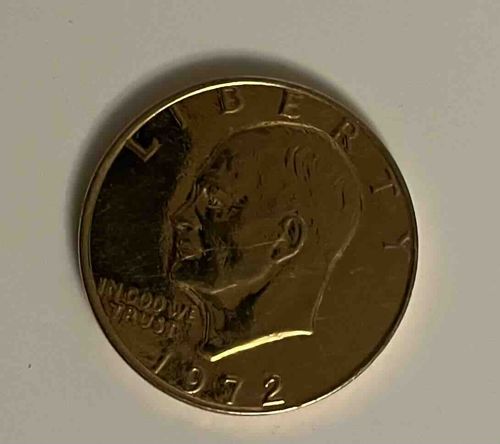
This item is identified as a 1972 Kennedy Half Dollar coin. The physical characteristics visible include its round shape and metallic, golden-yellow hue, which suggests it might be gold-plated or made of a brass/bronze alloy, as typical Kennedy Half Dollars of this era were composed of a copper-nickel clad. The obverse side is clearly depicted, featuring the left-facing profile of John F. Kennedy. Above his head, the word "LIBERTY" is partially visible along the top edge, and below his chin, the motto "IN GOD WE TRUST" is prominently displayed. The date "1972" is clearly inscribed along the bottom curve of the coin. The surface appears to have a semi-proof-like finish, with reflective fields, though there are visible signs of wear consistent with circulation or handling, such as faint scratches and possibly some minor rim nicks. There are no obvious maker's marks or mint marks discernible in the provided image to ascertain the specific mint location. The overall quality appears to be average for a circulated coin of its age, with good retention of details on Kennedy's effigy. The unusual aspect is its gold color, as standard 1972 Kennedy Half Dollars are silver-colored (copper-nickel clad). This could indicate a special issue, a privately gilded coin, or an error, which would significantly impact its value beyond its face value.
AI Appraisal Report
I have examined the provided image of what is identified as a 1972 Kennedy Half Dollar, noting its distinct gold-toned appearance. Based on the visual evidence, the coin appears to be a genuine 1972 Kennedy Half Dollar regarding its design and date, despite the unusual coloration. The obverse details, including Kennedy's effigy, "LIBERTY," "IN GOD WE TRUST," and the "1972" date, are consistent with authentic issues. The surface exhibits a semi-proof-like finish with reflective fields, though faint scratches and minor rim nicks suggest circulation or handling. Standard 1972 Kennedy Half Dollars are copper-nickel clad and silver-colored; therefore, this gold tone indicates either post-mint alteration (e.g., gold plating), a private minting, or a rare error. Without a discernible mint mark, its origin beyond the U.S. Mint is unclear. Given the typical value of a circulated 1972 Kennedy Half Dollar (usually face value or slightly more for uncirculated examples), the gold toning is the primary factor influencing its potential value. If it's a private mint issue or a gilded coin, its value would largely depend on the specific market for such novelty items, which is generally low unless associated with a reputable private mint. If, by an extreme rarity, it were an official mint error involving unintended metal composition, its value would skyrocket. However, this is exceptionally unlikely without clear provenance. My assessment is limited without physical examination to confirm the metal composition, density, and to rule out post-mint alteration. A professional numismatic opinion, often requiring in-person inspection and potentially spectroscopic analysis, is essential to definitively determine if it's an authentic error or a gilded coin, and to assess its precise condition (e.g., identifying specific marks or luster). Without such verification, it's best treated as a curiosity rather than a high-value collectible.