AI estimate as of October 27, 2025 · verify with a professional before acting
AI-Generated · Verify before acting
Everything on this page is generated by AI for informational purposes only. AI can make mistakes — the AI may misidentify items or misattribute them (artist, maker, brand, designer, origin, era). This is not an official valuation and should not be used for insurance, sale, tax, estate, legal, or lending purposes — or any decision requiring a certified appraisal. It is not an authoritative claim about any person, brand, or rights holder — do not share or rely on it as a factual statement about a third party. Always consult qualified professionals before making financial decisions.
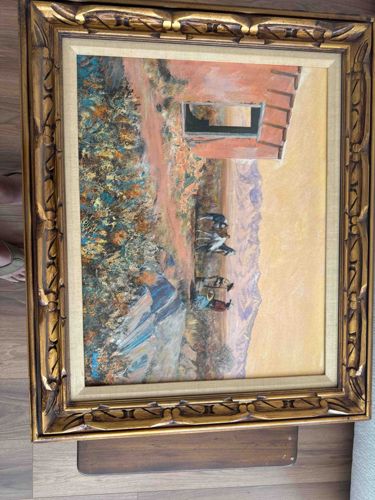
This is an oil painting depicting a Southwestern landscape scene, rendered in a style that suggests impasto techniques and possibly an impressionistic or post-impressionistic influence, with visible brushstrokes creating texture. The composition features a prominent adobe-style structure in the upper right, with a dark, open window revealing an interior or deep recess. A reddish-brown pathway or dirt road winds from the foreground towards the middle ground. To the left, dense, multi-colored foliage is depicted with thick applications of paint, incorporating shades of green, blue, brown, and ochre, giving it a somewhat abstract or mosaic-like quality. In the mid-ground, several small figures are visible, possibly human and animal, standing or walking along the path. These figures are rendered with less detail than the surrounding landscape elements but add a sense of narrative and scale to the scene. The background reveals a range of mountains under what appears to be a warm, possibly sunset or sunrise sky, transitioning from lighter yellow-orange hues to deeper mauves and purples in the distance. The painting is housed within a substantial, ornate gilded frame. The frame features a classic design with repeating decorative elements, likely molded or carved, demonstrating a traditional aesthetic. The gold finish appears aged, with some areas possibly showing wear or a deliberate antiqued patina, characteristic of frames from the mid-20th century. The inner edge of the frame has an additional thin, lighter colored liner, possibly linen or a painted wood strip, providing a visual separation between the main frame and the artwork itself. The overall condition appears good, with no obvious signs of significant damage or repair visible from the provided image. The visible texture of the paint suggests a focus on light and color interpretation over precise realistic detail. The piece likely dates from the mid to late 20th century, consistent with the style of painting and framing.
AI Appraisal Report
This Southwestern Landscape Painting with Figures, an oil on canvas, presents in what appears to be good condition based on the provided image. The impasto technique, visible brushwork, and color palette suggest an impressionistic or post-impressionistic influence, characteristic of artworks from the mid to late 20th century. The painting depicts an adobe structure, winding path, multi-colored foliage, and distant mountains under a warm sky, with small figures adding narrative. The artwork is housed in a substantial, ornate gilded frame with an inner liner, consistent with the probable age of the painting and generally well-preserved.
Market conditions for unsigned Southwestern landscapes of this style are generally stable but not experiencing significant growth. Comparables include works by regional artists sold in local galleries or secondary markets, typically ranging from $400 to $1,000 for similar size and quality. The piece is not exceptionally rare, as many artists depicted similar scenes during this period. Demand is moderate, appealing to collectors of regional art or those seeking decorative pieces for Southwestern-style interiors. Factors impacting value positively include the appealing composition and vibrant colors; however, the lack of an identifiable artist or signature, which cannot be determined from the image, significantly limits its potential value as fine art. The figures also contribute to the appeal. The ornate frame adds to the presentation value.
Limitations in authenticity verification are significant. Without an in-person examination, I cannot definitively confirm medium, exact dimensions, or condition details such as craquelure, exact surface anomalies, or potential restoration. Full authentication would require a physical inspection to look for a signature or artist's mark, assess the paint and canvas characteristics, and review any provenance documentation. Scientific testing, such as pigment analysis, would be necessary to confirm dating conclusively. Without these, the appraisal reflects its value as a decorative unsigned work.