These notes were written by the person who submitted this item. Appraiser.AI has not verified them, and the AI's identification and estimate may rely on them.
AI Estimated Value
Not an official valuation
$5,000 - $12,000
AI estimate as of November 22, 2025 · verify with a professional before acting
AI-Generated · Verify before acting
Everything on this page is generated by AI for informational purposes only. AI can make mistakes — the AI may misidentify items or misattribute them (artist, maker, brand, designer, origin, era). This is not an official valuation and should not be used for insurance, sale, tax, estate, legal, or lending purposes — or any decision requiring a certified appraisal. It is not an authoritative claim about any person, brand, or rights holder — do not share or rely on it as a factual statement about a third party. Always consult qualified professionals before making financial decisions.
This analysis also relies on unverified notes provided by the user, which may be incomplete or inaccurate and could affect the result.
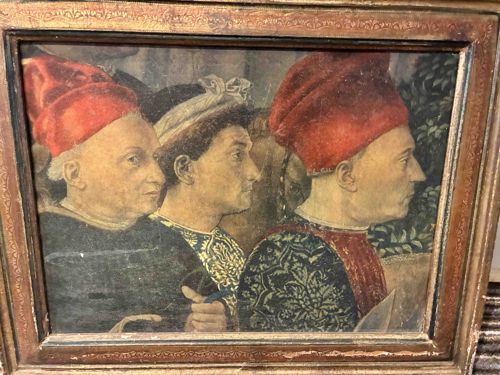
This appears to be a framed fragment of a fresco or a painting executed in a fresco-like style, depicting three male figures in profile, indicative of late medieval or early Renaissance portraiture. The image focuses on the busts and heads of the men, with faces rendered in pale skin tones and subtle shading. Each figure wears distinct headwear and period attire. The figure on the far left, an older man, wears a voluminous, bright red cap common in the Italian Renaissance, possibly a 'beretta' or 'cappa'. He has white hair peeking from under his cap and a slightly furrowed brow. The middle figure, younger, sports a lighter-colored, possibly striped or textured, round cap. His garment features a patterned brocade-like fabric. The man on the far right also wears a similar vivid red cap and a dark garment with an intricate, possibly embroidered or brocaded, green and black pattern, with a red collar under it. The background behind the figures is indistinct, suggesting either an indoor setting or a stylized landscape, with hints of foliage visible behind the rightmost figure.
The overall condition shows significant signs of age and wear. The colors, while still vibrant in areas like the red caps, display fading and discoloration consistent with old pigments and exposure. There are visible cracks, abrasions, and areas of paint loss across the surface, particularly noticeable on the left-most figure's dark garment and in the background. The surface also exhibits a dullness and accumulation of grime or varnish degradation, obscuring some details. The item is housed in an antique wooden frame, likely gilt, which also shows considerable wear and deterioration, with chips, losses to the gesso and gilding, and a general aged patina, particularly along the inner and outer edges. The craftsmanship, though aged, suggests a skilled hand, typical of the stylistic conventions of Italian Renaissance art, particularly portraiture and narrative scene painting, and likely dates from the 14th to 16th centuries. The composition, featuring multiple profiles, is reminiscent of narrative friezes or parts of larger religious or secular historical scenes found in frescoes of the era. The limited background information suggests it could be a section of a much larger work, carefully removed and re-framed.
AI Appraisal Report
Upon examining this 'Fragment of a Renaissance Fresco Depicting Three Men in Profile,' I observe characteristics strongly consistent with late medieval or early Renaissance Italian painting. The stylistic execution, particularly the profile portraits, headwear, and patterned garments, aligns with artistic conventions of the 14th to 16th centuries. The vibrant remnants of color, especially the red caps, betray once-rich pigments typical of the era. However, the condition is fair at best, exhibiting significant cracking, abrasions, paint loss, and general grime accumulation, all consistent with extreme age and potential environmental exposure. The antique gilt frame, while charmingly aged, also shows considerable deterioration.
Authenticity from images alone is fraught with challenges. While the style strongly suggests genuine antiquity, determining if this is an actual fresco fragment, a painting in fresco-like style, or indeed an original Renaissance piece versus a later imitation or copy, is impossible without physical examination. A proper in-person inspection would allow for pigment analysis, stratigraphy to confirm fresco layers, infra-red reflectography to examine underdrawings, and UV light examination to detect overpainting or repairs. Provenance documentation, detailing the fragment's origin and ownership history, would be critical for full authentication.
Regarding market conditions, genuine, albeit fragmentary, Renaissance works can command significant values, driven by rarity and historical importance. Comparables would include smaller fragments or studies attributed to workshops of masters of the period. The market for such items is specialized, appealing to dedicated collectors and institutions. The limitations of its fragmentary nature and condition reduce its value compared to a complete, well-preserved work. However, its aesthetic appeal and the compelling historical period it represents maintain a notable demand.
Given the current visual information and the numerous unknowns without physical testing and provenance, I estimate its value to be in the range of $5,000 - $12,000. This appraisal assumes a high probability of it being a genuine period piece, but the lower end reflects the substantial condition issues and the uncertainty of its exact origin and method of execution without further verification. Should it be definitively attributed to a specific renowned workshop or master, its value could increase substantially.