AI estimate as of September 28, 2025 · verify with a professional before acting
AI-Generated · Verify before acting
Everything on this page is generated by AI for informational purposes only. AI can make mistakes — the AI may misidentify items or misattribute them (artist, maker, brand, designer, origin, era). This is not an official valuation and should not be used for insurance, sale, tax, estate, legal, or lending purposes — or any decision requiring a certified appraisal. It is not an authoritative claim about any person, brand, or rights holder — do not share or rely on it as a factual statement about a third party. Always consult qualified professionals before making financial decisions.
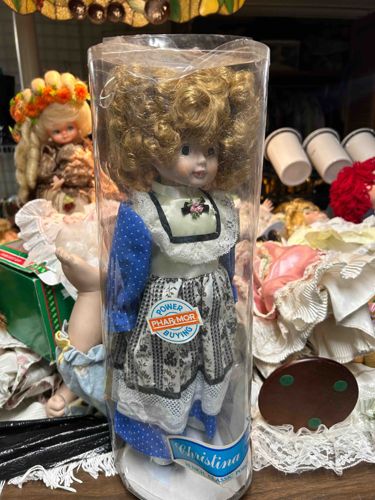
The item is a porcelain doll, identified as 'Christina' from a label on its packaging, presented in what appears to be its original clear plastic cylindrical container. The doll features a pale, rosy complexion on its visible face, indicating a porcelain or bisque head. It has distinctly curly, light brown or blonde hair styled in a voluminous manner, framing its face. The eyes are dark, likely painted, and the mouth is gently closed. The doll is attired in a traditional-style dress, consisting of a blue and white polka-dotted top or bodice with long sleeves, a white and black patterned skirt featuring floral or botanical motifs, and a white lace-trimmed apron. The apron has a small, embroidered floral embellishment, possibly roses, at the center front top. The packaging includes a circular sticker that reads 'POWER PHAR MOR BUYING' in blue and red text, suggesting it was a promotional or exclusive item. The doll's overall condition appears excellent, likely due to being enclosed in its packaging, which also shows no significant signs of damage, scuffs, or yellowing that would indicate prolonged exposure or age. The base of the packaging has a label with 'Christina' printed in an elegant script, framed by a light blue banner. The visible parts of the doll suggest a traditional craftsman-style construction, typical of collectible porcelain dolls common from the late 20th century.
AI Appraisal Report
I have visually examined the 'Christina' Porcelain Doll presented within its original clear plastic cylindrical packaging. The doll appears to be in excellent, 'new old stock' condition, protected by its packaging which shows no significant signs of wear, scuffs, or yellowing. The pale complexion, curly hair, traditional attire, and the overall presentation suggest a mass-produced collectible porcelain doll, likely from the late 20th century. The 'POWER PHAR MOR BUYING' sticker indicates it was potentially a promotional item or part of a larger retail chain's exclusive offerings. Authenticity, based on visual examination alone, points to it being a genuine 'Christina' doll as labeled, consistent with similar mass-market collectible dolls of the era.
Market conditions for such dolls are generally soft. While once popular, demand for mass-produced porcelain dolls has significantly decreased over the past decades. This doll does not exhibit characteristics typically associated with rare, artist-signed, or historically significant pieces (e.g., specific manufacturer hallmarks, limited edition numbers, exceptional hand-painting detail). Comparables in similar condition, still in original packaging, from this period typically retail in the $20-$50 range, with factors like the doll's specific aesthetic appeal and packaging condition pushing toward the higher end. The 'POWER PHAR MOR BUYING' sticker is unlikely to enhance value significantly.
Factors impacting value include its pristine condition in original packaging, which is a positive. However, the mass-produced nature and general lack of strong collector demand for these types of dolls are significant downward pressures. To definitively confirm authenticity and ascertain potential manufacturer details that might influence value, an in-person examination would be required to check for any hidden manufacturer marks on the doll itself, assess the quality of the porcelain, and determine if any certificates of authenticity are present within the packaging. Without physical inspection, I cannot verify the material of the body (often cloth or plastic beneath the porcelain head), the quality of craftsmanship beyond surface appearance, or confirm that no damage exists unseen within the packaging.