AI estimate as of December 11, 2025 · verify with a professional before acting
AI-Generated · Verify before acting
Everything on this page is generated by AI for informational purposes only. AI can make mistakes — the AI may misidentify items or misattribute them (artist, maker, brand, designer, origin, era). This is not an official valuation and should not be used for insurance, sale, tax, estate, legal, or lending purposes — or any decision requiring a certified appraisal. It is not an authoritative claim about any person, brand, or rights holder — do not share or rely on it as a factual statement about a third party. Always consult qualified professionals before making financial decisions.
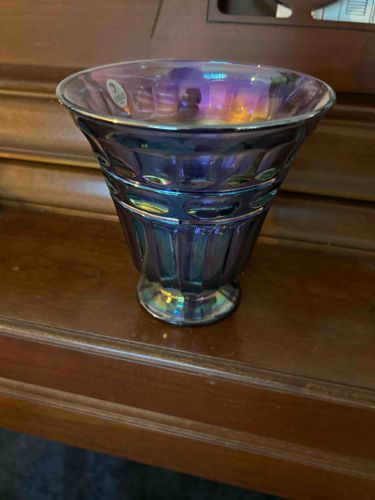
This is an iridescent vase, likely made of carnival glass, exhibiting a striking amethyst or deep purple hue with a strong iridescent sheen that reflects a spectrum of colors, including blues, greens, yellows, and purples, depending on the lighting and viewing angle. The vase features a flared rim, a wide mouth, and a tapering body that narrows towards a defined footed base. The main body of the vase is adorned with distinct vertical paneling or fluting, creating a ribbed texture. Approximately one-third down from the rim, there's a horizontal band featuring a repeating pattern of embossed oval or circular motifs, adding a decorative element to its surface. Below this band, the vertical paneling continues to the base. The construction appears to be molded glass, characteristic of carnival glass production. There is a small, light-colored sticker or label attached near the rim, which might be a manufacturer's mark, a retail tag, or an inventory label; however, its details are not discernible from the image. The surface appears smooth and glossy, with no immediately visible chips, cracks, or significant damage, suggesting it is in good overall condition. The iridescent finish is vibrant and well-preserved, indicating good quality. Given the style and iridescence, it likely dates from the early to mid-20th century, a period when carnival glass was highly popular. The craftsmanship suggests a commercially produced item, possibly a decorative household furnishing.
AI Appraisal Report
I have examined the provided image of this Iridescent Amethyst Carnival Glass Vase. Based on its visual characteristics, it presents as an authentic piece of carnival glass, likely produced in the early to mid-20th century. The strong iridescent sheen displaying a spectrum of colors, coupled with the amethyst base glass and molded vertical paneling with an embossed oval motif band, are all consistent with typical carnival glass manufacturing. The overall condition appears to be very good; the surface is glossy, and there are no immediately visible chips, cracks, or significant damage, which would negatively impact value. The iridescence is vibrant and well-preserved.
In terms of market conditions, carnival glass is a well-established collectible market. While certain patterns and makers can command high prices, this particular vase exhibits characteristics more typical of commercially produced, mass-market carnival glass. The pattern, while attractive, does not appear to be a rare or highly sought-after design from prominent manufacturers like Fenton or Northwood, which often bring premium prices. Demand for good quality, common carnival glass remains steady, driven by collectors and those seeking decorative vintage items. Rarity for this specific form and pattern is moderate; similar pieces appear regularly in the secondary market. Factors significantly impacting value include the excellent condition and the attractive amethyst color, which is a popular hue among collectors.
However, it is important to note the limitations of an appraisal based solely on images. While the visual evidence strongly suggests authenticity and good condition, an in-person examination would be necessary to confirm the absence of minute flaws, internal cracks, or repairs that are not discernible from photographs. Physical inspection would also allow for a more definitive identification of the maker, if possible from an unmarked base or mold lines. The small sticker near the rim, if legible upon closer inspection, could provide valuable provenance or maker information. Without physical examination, I cannot definitively confirm its authenticity or rule out any subtle manufacturing defects or subsequent damage. Nevertheless, based on the clear image, its condition and aesthetic appeal support the estimated value.