AI Appraisal Estimate

AI-generated estimates · not official valuations

From the user

What was submitted

Photo and notes provided by the user — not generated by AI

Submitted item photo
Submitted photo · June 22, 2026

User's notes

No additional notes provided.

AI analysis below

AI appraisal

AI analysis & estimate

AI-Generated · Verify before acting

Everything below is generated by AI for informational purposes only. AI can make mistakes — the AI may misidentify items or misattribute them (artist, maker, brand, designer, origin, era). This is not an official valuation and should not be used for insurance, sale, tax, estate, legal, or lending purposes — or any decision requiring a certified appraisal. It is not an authoritative claim about any person, brand, or rights holder — do not share or rely on it as a factual statement about a third party. Always consult qualified professionals before making financial decisions.

Read the full disclaimer

AI Identification

·Not independently authenticated·Verify before acting

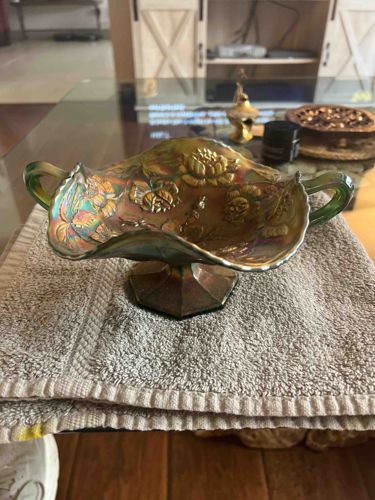
Carnival Glass Two-Handled Bon Bon Dish

Antique Glassware / Collectible Art Glass

AI Estimated Value

·Not an official valuation·Verify before acting

$65.00 - $95.00

As of June 22, 2026

AI Item Analysis

·AI can make mistakes·Verify before acting
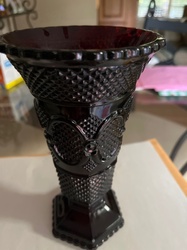
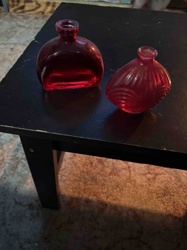
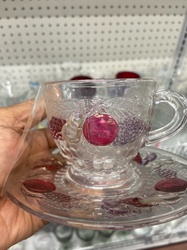
This is a vintage carnival glass bon bon dish, likely produced by an American manufacturer such as Fenton, Northwood, or Imperial Glass during the early to mid-20th century. The piece features a deep 'marigold' or 'green' iridescent finish that exhibits a strong rainbow luster across the interior and exterior surfaces. The vessel is constructed of pressed glass with a ruffled or crimped rim, typical of the Art Nouveau influence on American decorative glassware. The interior pattern displays a high-relief embossed floral design, specifically a pond lily or lotus motif with detailed petals and foliage. The dish is supported by a pedestal base with a hexagonal foot, providing stability. Two elegant, curved loop handles are attached symmetrically to the sides. Physically, the item appears to be made of green base glass, which contributes to the dark, multi-chromatic sheen. The craftsmanship is high, with clear definitions in the mold-work. Visible condition appears good with no obvious large chips or cracks, though some minor surface wear and factory straw marks (shear marks) or bubbles inherent to the era's manufacturing process may be present upon closer inspection. The iridescence is well-preserved, showing vibrant flashes of gold, pink, and teal.
AI Appraisal Report

·AI can make mistakes·Verify before acting
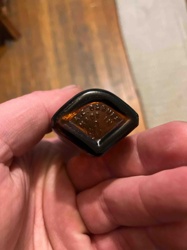
I have conducted a visual analysis of this carnival glass bon bon dish, which exhibits characteristics consistent with the 'Pond Lily' pattern, most notably produced by Fenton Art Glass around 1911. The green base glass combined with a vibrant iridescent finish—showing rich gold and teal highlights—is a hallmark of quality 'Classic' era carnival glass. My examination shows the mold-work is crisp, and the handles appear securely attached with no heat-checks or stress fractures visible at the points of fusion. Market demand for marigold and green common patterns remains steady among specialized collectors, though values have softened from their early-2000s peak. Comparables for this specific two-handled ruffled shape generally fall in the sub-$100 range, as it was a high-production item. This piece is valued toward the higher end of its bracket due to the exceptional luster and lack of significant 'silvering' or loss of iridescence on the raised relief. Please note that this appraisal is based on photographic evidence only. A physical inspection is required to confirm the absence of 'flea bites' on the base and to verify the glass weight. While the pattern and color are consistent with Fenton, the absence of an embossed 'F' in an oval suggests it is a true vintage piece rather than a 1970s reissue; however, microscopic analysis of wear patterns on the foot ring would be necessary to definitively confirm its 110-year age and rule out modern reproductions. No scientific testing is required for this class of glassware, but provenance regarding its storage environment would support its condition grading.

Get your items appraised

Instant estimates of your treasures with AI-powered appraisals

Browse More Appraisals