AI estimate as of November 21, 2025 · verify with a professional before acting
AI-Generated · Verify before acting
Everything on this page is generated by AI for informational purposes only. AI can make mistakes — the AI may misidentify items or misattribute them (artist, maker, brand, designer, origin, era). This is not an official valuation and should not be used for insurance, sale, tax, estate, legal, or lending purposes — or any decision requiring a certified appraisal. It is not an authoritative claim about any person, brand, or rights holder — do not share or rely on it as a factual statement about a third party. Always consult qualified professionals before making financial decisions.
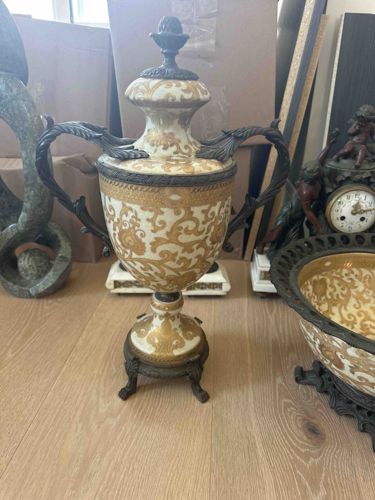
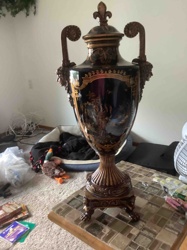
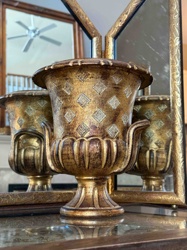
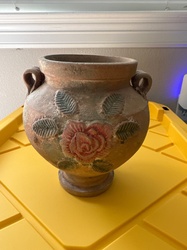
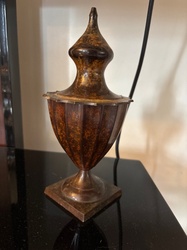
This is a decorative neoclassical-style urn, featuring a ceramic or porcelain body adorned with ornate gilt decoration, likely representing a scrollwork or foliate pattern. The primary colors of the ceramic are off-white or cream, complemented by the rich gold detailing. The urn is characterized by its substantial size, though exact dimensions are not provided, it appears to be a tabletop-sized piece. It has a distinctly elegant, classical silhouette, widening towards the middle and tapering towards the base and neck. A fitted lid, also decorated with complementary gilt patterns and topped with a finial resembling a pineapple or acanthus leaf, adds to its grandeur. The most striking features are the dark-toned, possibly bronze or heavily patinated metal handles, shaped like intertwining branches or stylized serpents, that extend from the rim of the urn to its shoulders. These handles exhibit a textured, almost organic quality, suggesting a cast metal construction. The urn rests on a matching dark metal tripod base, intricately cast with scrolling motifs that mirror the decorative style of the handles. Visible condition issues include what appears to be some wear or slight discoloration on the metal components, consistent with age and handling. The gilt decoration on the ceramic might also show minor abrasions or fading in areas, though it largely retains its vibrancy. No specific maker's marks or signatures are discernible from the image, preventing precise manufacturing attribution. Based on its style, materials, and ornate detailing, the urn likely dates to the late 19th or early 20th century, drawing inspiration from classical Roman or Greek forms with a Rococo or Baroque influence in its ornamentation. The craftsmanship displayed, particularly in the detailed casting of the metalwork and the hand-painted appearance of the gilt, indicates a quality decorative object. Its unique combination of patterned ceramic and sculptural metal elements makes it a prominent decorative accent piece.
AI Appraisal Report
I have examined the provided image of this Neoclassical Style Handled Urn with Lid. The item presents as a high-quality decorative object, likely late 19th to early 20th century. Its Neoclassical form, combined with Rococo or Baroque-influenced gilt decoration on an off-white ceramic or porcelain body, is visually appealing. The dark-toned, sculptural metal handles, resembling intertwining branches, and the matching tripod base are particularly striking, indicating fine craftsmanship, possibly cast bronze or a heavily patinated metal.
Condition-wise, minor wear and discoloration on the metal components are visible, consistent with age. Subtle abrasions or fading on the gilt decoration are also plausible, though overall vibrancy appears maintained. These are expected for an item of this vintage and do not significantly detract from its decorative value. The combination of patterned ceramic and sculptural metal elements makes it a prominent accent piece.
Market conditions for such decorative urns remain stable, with demand driven by interior decorators and collectors seeking classical aesthetic pieces. Comparables typically sell in the $500-1,000 range, depending on condition, size, and the quality of metalwork and ceramic. The detailed casting and overall decorative impact suggest a higher-end decorative item. Rarity is moderate; while not unique, the specific combination of high-quality materials and intricate design elevates its appeal.
Factors significantly impacting value include the artistic quality of the metalwork and the condition of both the ceramic and gilt decoration. The absence of discernible maker’s marks is a limiting factor for definitive authentication and can slightly suppress value compared to signed examples by renowned manufacturers. For full authentication, an in-person examination is crucial to assess the material composition (ceramic vs. porcelain; bronze vs. other metals), the method of decoration (hand-painted vs. transferware), and to thoroughly evaluate any repairs or hidden damage. Provenance documentation, if available, would further enhance its historical and market value.