These notes were written by the person who submitted this item. Appraiser.AI has not verified them, and the AI's identification and estimate may rely on them.
AI Estimated Value
Not an official valuation
$10-30
AI estimate as of July 19, 2025 · verify with a professional before acting
AI-Generated · Verify before acting
Everything on this page is generated by AI for informational purposes only. AI can make mistakes — the AI may misidentify items or misattribute them (artist, maker, brand, designer, origin, era). This is not an official valuation and should not be used for insurance, sale, tax, estate, legal, or lending purposes — or any decision requiring a certified appraisal. It is not an authoritative claim about any person, brand, or rights holder — do not share or rely on it as a factual statement about a third party. Always consult qualified professionals before making financial decisions.
This analysis also relies on unverified notes provided by the user, which may be incomplete or inaccurate and could affect the result.
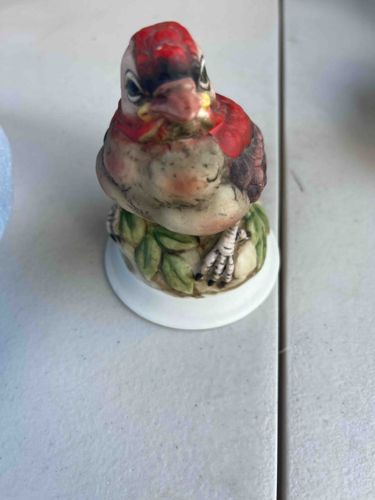
This item is a small, hand-painted ceramic or porcelain figurine depicting a bird, specifically identified by the context as a Cardinal B-743 from Melvin China. The bird figure is predominantly white or very light cream-colored on its body, serving as a base for painted details. The head and upper back of the bird feature a vibrant red coloration, indicative of a male cardinal. There are subtle brushstrokes and shading, suggesting an attempt at realism in the feathering, particularly around the wings and tail, which appear to be painted in shades of brown and possibly dark red. The bird's eyes are dark, appearing as painted dots with a small white highlight to simulate a reflective quality, and it has a noticeable beak that is somewhat flattened or truncated, painted in a yellow or light brown hue. The bird is perched on a green base molded to resemble foliage or a small bush, with visible leaf details. Its delicate feet, painted in a light color with black claws, are sculpted to grip this naturalistic base. The entire bird figure is mounted on a smooth, circular white pedestal or base. The craftsmanship appears to be of a reasonable quality for mass-produced decorative ceramics. Visible condition issues include some apparent dust or residue on the figurine which could simply be surface dirt, and possibly some minor paint loss or scuffing on the red areas of the head, though this is difficult to ascertain definitively from the image. The style suggests a mid to late 20th-century production, typical of ceramic bird figurines made for decorative purposes. The 'Melvin China' context implies a brand or manufacturer, suggesting factory production rather than a unique, artisan piece, and 'Cardinal B-743' likely refers to a specific model number within their line of bird figurines.
AI Appraisal Report
Upon examining the provided image of the Melvin China Cardinal B-743 figurine, I observe a charming, hand-painted ceramic piece. The condition appears to be relatively good, though I note some apparent surface dust or residue, and potential minor paint loss on the red areas, which would require physical inspection to confirm. Authenticity, based on the "Melvin China" and "Cardinal B-743" designation, suggests a factory-produced item rather than a unique artisan piece. The style is consistent with mid-to-late 20th-century decorative ceramics.
In terms of market conditions, mass-produced ceramic bird figurines from this era generally fall within the decorative collectibles segment. Comparables from similar manufacturers like Napco, Lefton, or Enesco, which produced a wide variety of animal and bird figurines, typically sell for modest sums. Demand for such items is generally low to moderate, driven primarily by individual collectors or those seeking nostalgic decorative pieces. Rarity is not a significant factor here; these were mass-produced. Factors impacting value negatively include the commonality of the item, the lack of significant artistic merit (beyond decorative appeal), and any condition issues like chips, cracks, or significant paint loss not discernible from the image.
Limitations to this appraisal are significant due to the reliance on static images. A definitive assessment of condition (e.g., presence of hairline cracks, actual paint loss vs. surface dirt, crazing), and a full authentication of the 'Melvin China' mark itself (though less critical for mass-produced items) would require in-person examination. Physical inspection would also allow for verification of materials, and a more precise evaluation of craftsmanship, which influences appeal and value. Provenance documentation, while not usually critical for common decorative items, could enhance value if it linked the piece to a notable collection or history, though this is rare for such figurines.