AI estimate as of October 14, 2025 · verify with a professional before acting
AI-Generated · Verify before acting
Everything on this page is generated by AI for informational purposes only. AI can make mistakes — the AI may misidentify items or misattribute them (artist, maker, brand, designer, origin, era). This is not an official valuation and should not be used for insurance, sale, tax, estate, legal, or lending purposes — or any decision requiring a certified appraisal. It is not an authoritative claim about any person, brand, or rights holder — do not share or rely on it as a factual statement about a third party. Always consult qualified professionals before making financial decisions.
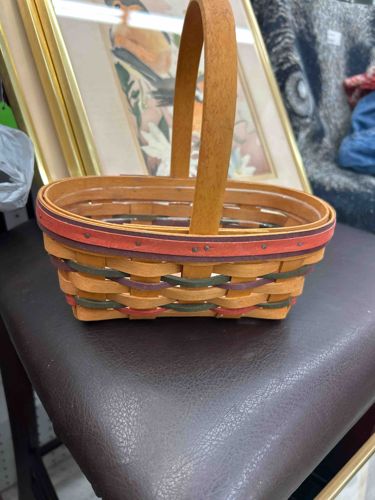
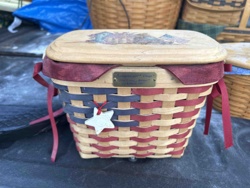
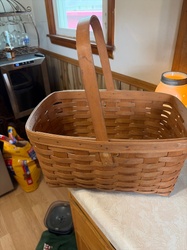
This item is a small, oval-shaped woven wood basket, featuring a single, fixed wooden handle. The primary construction material appears to be thin strips of light-colored wood, likely maple or similar, woven together. The base and sides are formed by interlacing these natural wood strips with horizontally woven strips in various colors: red, green, and a dark purplish-brown. These colored strips create a repeating pattern around the body of the basket. The rim of the basket is reinforced with a wider band of similarly colored wood, predominantly red with a darker trim, possibly secured with small metal tacks or rivets, which are visible along the top edge of this rim. The handle is a single, relatively thick, light-colored wooden strap that arches over the basket, secured at opposite ends of the rim. The overall condition appears to be good with some minor signs of wear consistent with age and use, such as slight discoloration or scuffing on the wood, particularly on the handle, indicating a vintage or pre-owned item. There are no obvious signs of significant damage, breaks, or repairs. The weaving is tight and consistent, suggesting good craftsmanship. The multi-colored weave and oval shape are characteristic of baskets produced in the style of Longaberger Baskets, which were popular for their handcrafted quality and distinctive design. The size appears suitable for decorative purposes, holding small items, or as a gift basket.
AI Appraisal Report
I have examined the provided image of this Longaberger-style woven wood basket. Based on the visual evidence, the basket appears to be in good overall condition, displaying minor wear consistent with its likely vintage nature. There are no apparent breaks, significant damage, or repairs, and the weaving is tight and consistent, suggesting good craftsmanship. The multi-colored weave, oval shape, and fixed wooden handle are indeed characteristic features often associated with Longaberger Baskets or baskets made in a similar style. While the craftsmanship is evident, I cannot definitively authenticate it as a genuine Longaberger product solely from an image. A definitive authentication would require an in-person examination to check for maker's marks, specific weaving patterns unique to Longaberger, basket liner presence, or production tags, which are typically found on authentic pieces. Without these, it falls into the category of 'Longaberger-style.'
Market conditions for such baskets, particularly those not definitively identified as authentic Longaberger with specific collection or year marks, are moderate. While true Longaberger baskets can fetch higher prices, particularly rare or retired editions, "style" pieces, even well-made ones, typically sell for less. Comparables for well-maintained, generic woven baskets of this size and style often range from $20 to $60. The aesthetic appeal of the colored weave adds to its decorative value, but it does not inherently increase its collector's premium without provenance.
Demand for decorative woven baskets remains steady, but rarity is low for generic or 'style' pieces. Factors impacting value include the lack of definitive maker identification, which keeps the price lower than authenticated Longaberger items. For full authentication, I would need to physically inspect the basket for any impressions, stamps, or labels on the base, rim, or handle, and potentially compare the wood types and weaving techniques against known Longaberger standards. Provenance documentation, such as original sales receipts or certificates, would also significantly aid in authentication.