AI Appraisal Estimate

AI-generated estimates · not official valuations

From the user

What was submitted

Photo and notes provided by the user — not generated by AI

Submitted item photo
Submitted photo · June 4, 2026

User's notes

Ceramic

AI analysis below

AI appraisal

AI analysis & estimate

AI-Generated · Verify before acting

Everything below is generated by AI for informational purposes only. AI can make mistakes — the AI may misidentify items or misattribute them (artist, maker, brand, designer, origin, era). This is not an official valuation and should not be used for insurance, sale, tax, estate, legal, or lending purposes — or any decision requiring a certified appraisal. It is not an authoritative claim about any person, brand, or rights holder — do not share or rely on it as a factual statement about a third party. Always consult qualified professionals before making financial decisions.

Note

This analysis also relies on unverified notes provided by the user, which may be incomplete or inaccurate and could affect the result.

Read the full disclaimer

AI Identification

·Not independently authenticated·Verify before acting

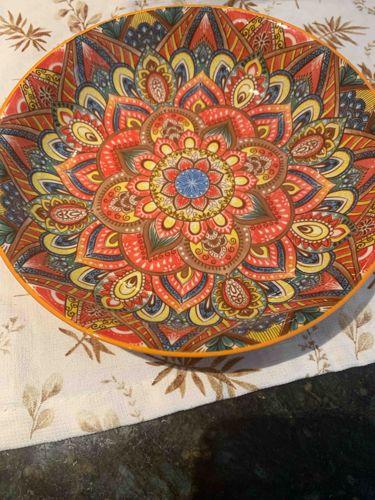
Ceramic Mandala Pattern Serving Bowl

Decorative Tableware

AI Estimated Value

·Not an official valuation·Verify before acting

$25-45

As of June 4, 2026

AI Item Analysis

·AI can make mistakes·Verify before acting
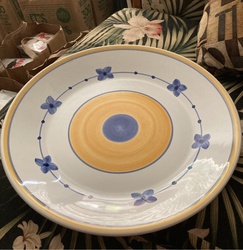
This is a vibrant and intricately decorated ceramic serving bowl or shallow dish. Its primary visual characteristic is the multi-layered, kaleidoscopic mandala-style pattern covering its entire interior surface. The color palette is rich and warm, dominated by various shades of orange, red, yellow, and blue, with accents of brown, teal, and cream. The design features concentric rings of stylized petals, teardrop shapes, and geometric motifs, with a central floral element in bright blue and red. The lines defining the pattern appear to be hand-drawn or hand-applied, giving it a slightly artisanal quality with subtle variations in line weight and color application. The bowl has a smooth, glossy finish, indicative of a glazed ceramic. The rim of the bowl is a solid bright orange, creating a distinct border for the intricate pattern. No visible chips, cracks, or significant wear are apparent from the provided image, suggesting it is in good to excellent condition. There are no discernible maker's marks or signatures visible on the interior. The style suggests a modern interpretation of traditional cultural patterns, possibly inspired by Bohemian or Indian art. It appears to be a mass-produced item designed for decorative and functional use. The overall craftsmanship seems to be of good quality, with clear printing or painting of the design, contributing to its aesthetic appeal.
AI Appraisal Report

·AI can make mistakes·Verify before acting
Upon examining the provided images and description, I have evaluated this ceramic serving bowl featuring a vibrant mandala pattern. The piece presents in excellent condition, with no visible chips, cracks, or crazing observed in the imagery. The glossy glaze is intact, and the intricate, multi-colored design is clear and well-applied, suggesting a high-quality mass-production process. The style is a modern interpretation of traditional Bohemian or Indian motifs, popular in contemporary home decor. The value of such decorative tableware is primarily driven by its aesthetic appeal and current market trends rather than by artist attribution or historical significance, as no maker's mark is visible. The market for this type of decorative ceramic is active but saturated, with numerous similar items available from retailers like Anthropologie, World Market, or independent online artisans. Comparable new, mass-produced bowls of this size and complexity typically retail between $35 and $60. In the secondary market, values are slightly lower, generally falling in the $20 to $40 range, depending on the platform and buyer demand. It is important to note the limitations of an appraisal based solely on images. Without a physical examination, I cannot definitively identify the manufacturer, confirm the material composition (e.g., stoneware vs. earthenware), or assess for subtle condition issues. A full authentication would require inspecting the underside for any impressed or printed marks that could help identify the maker and establish a more precise market comparable.

Get your items appraised

Instant estimates of your treasures with AI-powered appraisals

Browse More Appraisals