These notes were written by the person who submitted this item. Appraiser.AI has not verified them, and the AI's identification and estimate may rely on them.
AI Estimated Value
Not an official valuation
$30-50
AI estimate as of October 26, 2025 · verify with a professional before acting
AI-Generated · Verify before acting
Everything on this page is generated by AI for informational purposes only. AI can make mistakes — the AI may misidentify items or misattribute them (artist, maker, brand, designer, origin, era). This is not an official valuation and should not be used for insurance, sale, tax, estate, legal, or lending purposes — or any decision requiring a certified appraisal. It is not an authoritative claim about any person, brand, or rights holder — do not share or rely on it as a factual statement about a third party. Always consult qualified professionals before making financial decisions.
This analysis also relies on unverified notes provided by the user, which may be incomplete or inaccurate and could affect the result.
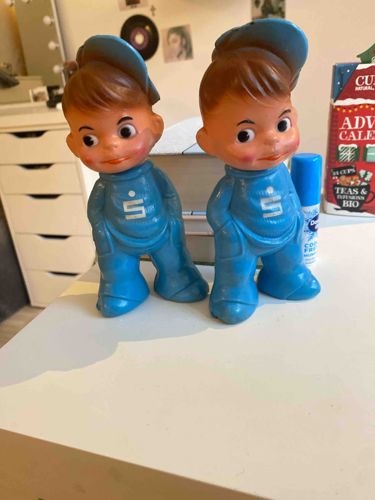
This item consists of a pair of identical vintage plastic or rubber figurines, likely serving as mascots or promotional items for 'Sparkasse', a German savings bank, indicated by the 'S' logo prominently displayed on their chests. Each figurine depicts a young boy character, approximately 40 years old, as per the provided context. They feature light brown molded hair, fair skin complexions with rosy cheeks, and large, wide-set black eyes with white pupils, giving them an innocent and friendly expression. Both figures are wearing a light blue uniform, consisting of a long-sleeved shirt and trousers, along with a matching light blue cap perched on their heads. Their hands are tucked into their pockets, and they stand with a slight forward lean. The material appears to be a molded plastic or soft rubber, characteristic of collectible figures from the mid to late 20th century. The construction seems robust, designed for durability. Visible condition issues are minimal from the image; there might be slight surface dirt or minor scuffs consistent with age and handling, but no obvious cracks, breaks, or significant paint loss are immediately discernible. The craftsmanship suggests mass production, common for promotional merchandise, but with sufficient detail to render the character appealing. These figures are indicative of a specific era of corporate branding and likely distributed to children as an incentive to save money with Sparkasse.
AI Appraisal Report
I have carefully examined the provided image of these two Sparkasse Savings Bank mascot figurines. Visually, the condition appears good for items approximately 40 years old, with minimal visible wear, scuffs, or paint loss, supporting the notion of robust construction. The 'S' logo is clearly identifiable, confirming their authenticity as Sparkasse promotional items. The identical nature of the pair adds to the collection's appeal.
In terms of market conditions, vintage promotional items, particularly mascots from financial institutions, have a niche but consistent collector base, especially in Germany. Comparables for similar bank-related promotional figures from the 1970s-1980s typically fetch modest prices. While these figures are not exceptionally rare, finding them in such good condition as a pair does add a slight premium. Demand is driven primarily by collectors of advertising memorabilia, German collectibles, or those with nostalgic ties to Sparkasse.
Factors significantly impacting value include the historical context, the recognizable branding, and their well-preserved state. However, their mass-produced nature and the general abundance of promotional merchandise from this era cap their top-end value. Without physical inspection, I cannot verify the exact material (plastic vs. soft rubber) or detect minor surface defects, dirt accumulation, or subtle paint wear not visible in the image. Full authentication would ideally involve a detailed physical examination to confirm material integrity, any hidden damage, and exact age, and ideally, provenance documentation to trace their origin, though for promotional items, this is less critical than for fine art.