Four-Panel Japanese Rimpa Style Landscape Screen
East Asian Fine Art

Four-Panel Japanese Rimpa Style Landscape Screen

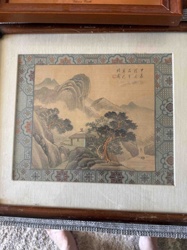
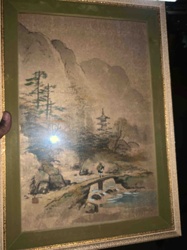
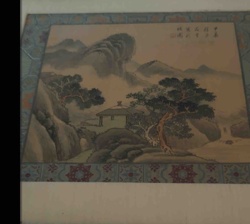
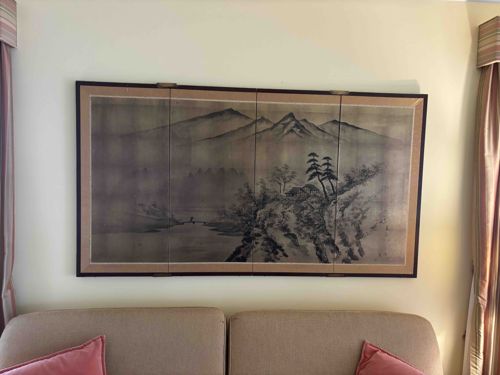
This is a four-panel Japanese screen (byōbu), currently mounted horizontally on a wall, featuring a classical ink landscape. The artwork is rendered in monochrome ink with subtle washes on a paper or silk substrate that has aged to a warm, golden-tan patina. The composition depicts a serene mountainous scene with jagged peaks in the background, a mist-filled valley, and a foreground featuring a rocky promontory with pine trees and a small footbridge or structure tucked into the cove. This style is characteristic of the Edo or Meiji periods, likely influenced by the Rimpa or Kanō schools. The screen is framed with a dark-lacquered wood border and traditional metal decorative plates (kahane) at the hinge points. Each panel shows vertical lines where the hinges or folds would be, indicating its original function as a folding floor divider. There are visible signs of moderate foxing and darkening across the surface, consistent with significant age. Slight creases and potential minor abrasions are visible near the panel intersections. The brushwork shows high-quality craftsmanship with varied ink density and confident strokes to suggest depth and atmospheric perspective. Based on the stylistic elements and the aging of the material, it likely dates to the late 19th or early 20th century.

Estimated Value

$4,500 - $6,500

Basic Information

Category

East Asian Fine Art

Appraised On

February 25, 2026

Estimated Value

$4,500 - $6,500

Item Description

This is a four-panel Japanese screen (byōbu), currently mounted horizontally on a wall, featuring a classical ink landscape. The artwork is rendered in monochrome ink with subtle washes on a paper or silk substrate that has aged to a warm, golden-tan patina. The composition depicts a serene mountainous scene with jagged peaks in the background, a mist-filled valley, and a foreground featuring a rocky promontory with pine trees and a small footbridge or structure tucked into the cove. This style is characteristic of the Edo or Meiji periods, likely influenced by the Rimpa or Kanō schools. The screen is framed with a dark-lacquered wood border and traditional metal decorative plates (kahane) at the hinge points. Each panel shows vertical lines where the hinges or folds would be, indicating its original function as a folding floor divider. There are visible signs of moderate foxing and darkening across the surface, consistent with significant age. Slight creases and potential minor abrasions are visible near the panel intersections. The brushwork shows high-quality craftsmanship with varied ink density and confident strokes to suggest depth and atmospheric perspective. Based on the stylistic elements and the aging of the material, it likely dates to the late 19th or early 20th century.

Get Your Items Appraised

Instant estimates of your treasures with AI-powered instant appraisals

Browse More Appraisals