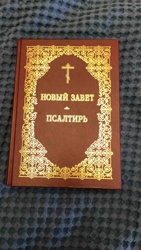
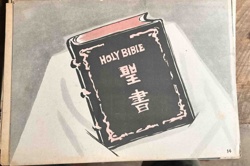
AI estimate as of July 18, 2025 · verify with a professional before acting
AI-Generated · Verify before acting
Everything on this page is generated by AI for informational purposes only. AI can make mistakes — the AI may misidentify items or misattribute them (artist, maker, brand, designer, origin, era). This is not an official valuation and should not be used for insurance, sale, tax, estate, legal, or lending purposes — or any decision requiring a certified appraisal. It is not an authoritative claim about any person, brand, or rights holder — do not share or rely on it as a factual statement about a third party. Always consult qualified professionals before making financial decisions.
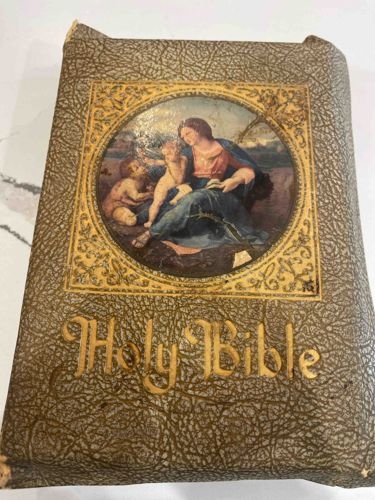
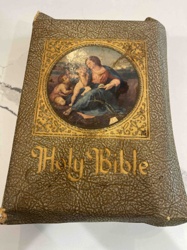
This item is an antique or vintage Holy Bible, likely from the late 19th to early 20th century. The cover appears to be made of a textured, possibly embossed or pressed material, imitating leather, in a mottled brownish-gray color. The texture is designed to mimic a crackled or pebbled pattern over the entire surface, lending it an aged, tactile quality. A prominent feature on the front cover is a centrally placed, oval-shaped image depicting what appears to be the Madonna and Child with another cherubic figure, characteristic of Renaissance or Baroque style religious art. This image is enclosed within an ornate, gold-toned border with intricate scrollwork and floral motifs, adding to its decorative appeal. Below this image, the words "Holy Bible" are embossed in a large, stylized, gold-colored script, further emphasizing the book's religious significance. The overall condition shows visible signs of age and wear. The edges and corners of the cover are noticeably worn, with some fraying or loss of material, particularly at the bottom left corner where the underlying structure is beginning to show. The surface of the cover exhibits minor scuffs, scratches, and discoloration consistent with extensive handling and age. The central image, while still largely intact, shows some loss of the protective finish or surface degradation, especially visible as lighter, perhaps abraded areas around the figures. The gold embellishments, both around the image and for the main title, show some fading or dullness, but much of their original luster and detail remains. The binding, though not fully visible, appears to be soft-backed, allowing for some flexibility and curvature of the book's spine, suggesting a well-loved or frequently used item. There are no readily discernible maker's marks or signatures visible on the front cover, but the craftsmanship of the embossing and the applied illustration indicate a commercially produced religious volume from its era, designed for devotional use. The quality suggests a mass-produced item, though with careful attention to decorative detail, typical of popular religious publications of the period.
AI Appraisal Report
Upon examining the provided image of this Antique Embossed Holy Bible with Madonna and Child Motif, I assess its condition as fair to good, consistent with an item of its presumed age, likely late 19th to early 20th century. The wear on the cover, particularly the fraying at corners and surface scuffs, is typical for a well-used devotional object. The embossed 'Holy Bible' and the gold-toned ornate border around the Madonna and Child image retain much of their detail, indicating a quality of craftsmanship, though some fading is evident. Authenticity, based solely on visual cues, suggests a commercially produced religious text from the period described. The style of the Madonna and Child motif aligns with popular religious art reproductions common in this timeframe.
Market conditions for antique Bibles vary widely. While extremely rare editions or those with significant historical provenance can command high prices, mass-produced devotional Bibles, even with decorative covers, generally fall into a more accessible price range. Comparables in similar condition with attractive, embossed covers typically sell for modest amounts. Demand is primarily from collectors of religious artifacts, antique book enthusiasts, and those seeking decorative historical pieces. This specific item is not exceptionally rare; similar decorated Bibles were produced in large quantities.
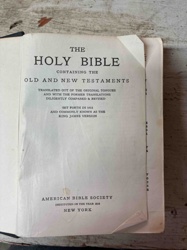
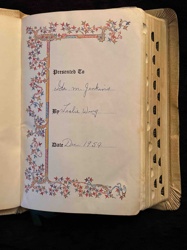
Factors significantly impacting its value include its age, the decorative cover, and the religious motif. The primary limitation in authenticity verification from an image alone is the inability to examine the interior pages for publisher details, date of publication, or any inscriptions. Without physical inspection, I cannot confirm materials, binding integrity, presence of illustrations within, or any unique characteristics that might increase value. Provenance documentation, if available, would significantly enhance its value by linking it to a specific history or owner. Scientific testing would be undue for this type of item given its likely market value.