AI estimate as of October 9, 2025 · verify with a professional before acting
AI-Generated · Verify before acting
Everything on this page is generated by AI for informational purposes only. AI can make mistakes — the AI may misidentify items or misattribute them (artist, maker, brand, designer, origin, era). This is not an official valuation and should not be used for insurance, sale, tax, estate, legal, or lending purposes — or any decision requiring a certified appraisal. It is not an authoritative claim about any person, brand, or rights holder — do not share or rely on it as a factual statement about a third party. Always consult qualified professionals before making financial decisions.
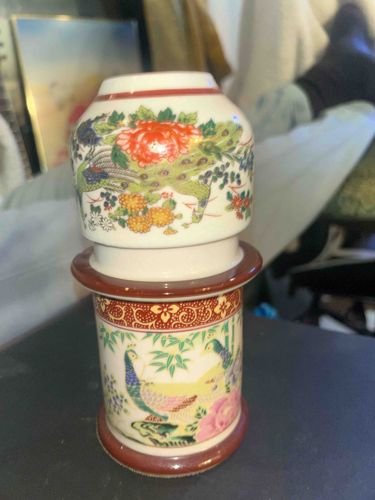
This item is a decorative porcelain stacking container, likely consisting of two separable sections. The overall form is cylindrical with a slight tapering towards the top of the upper section. The primary material is white porcelain, adorned with intricate, hand-painted polychrome decoration in an Imari or Kutani style, characterized by a rich palette of colors including vibrant oranges, reds, greens, blues, yellows, and pinks against a white ground. The upper section features a prominent, bold orange-red flower (possibly a peony or chrysanthemum) with detailed green foliage and other smaller floral motifs. Portions of what appears to be a peacock's plumage are visible, suggesting a bird motif integrated within the floral design. A thin red band encircles the rim of the upper section. The lower section maintains a cylindrical shape and is bordered at the top and bottom with a rich reddish-brown glaze that features an intricate repeating pattern in gold or lighter brown, resembling a stylized floral or geometric frieze. The main body of the lower section depicts two peacocks or similar fowl amidst bamboo shoots and pink floral elements. The peacocks exhibit colorful plumage with shades of blue, green, yellow, and red. The craftsmanship appears to be of good quality, with fine brushwork evident in the details of the birds and flowers. There are no immediately visible signs of chips, cracks, or repairs, suggesting good overall condition. The glazing appears uniform and glossy. The design aesthetic points to a Japanese origin, likely dating from the mid-20th century or possibly earlier, given the traditional artistry. The stacking nature suggests it may have been used for storing small trinkets, spices, or tea. The internal construction indicates two separate pieces designed to fit snugly. The brown glazed edges may be raised, providing a tactile element to the design.
AI Appraisal Report
I have carefully examined the provided image of this Japanese Imari-style porcelain stacking jar. Overall, the condition appears excellent, with no visible chips, cracks, or repairs, and a consistent, glossy glaze. The vibrant polychrome decoration, featuring rich oranges, reds, greens, blues, and yellows on a white ground, is characteristic of traditional Japanese Imari or possibly Kutani ware. The intricate hand-painted details of the prominent florales (peony/chrysanthemum), peacock plumage, bamboo, and other floral motifs suggest good craftsmanship and fine brushwork.
Authenticity, based solely on visual inspection of an image, is challenging to definitively confirm. While the style strongly points to a Japanese origin, likely mid-20th century or slightly earlier, a physical examination would be crucial to assess the quality of the porcelain body, the depth and texture of the glazes, and the precise firing techniques. Furthermore, checking for any maker's marks on the base, which are not visible in the provided image, would be essential for more specific attribution and dating. Without clear provenance—documentation of ownership history—or physical inspection, absolute authentication of age and origin remains an estimate.
In terms of market conditions, decorative Japanese porcelain, particularly Imari-style, sees steady but not exceptionally high demand unless it’s an antique piece from a renowned Kiln or artist. Comparables in good condition, generally dating from the mid-20th century, typically fetch between $150 and $400, depending on size, intricacy, and specific market trends. The stacking nature adds a degree of interest, suggesting potential utility as well as decorative appeal. The perceived rarity of such a piece is moderate; while well-executed, these types of decorative items were produced in some volume. The primary factors impacting value here are the apparent excellent condition and the detailed, colorful artistry. For a full authentication, I would require a direct physical examination to inspect the base for marks, assess the weight and quality of the porcelain, and detect any subtle restorations not visible on the image alone.