AI estimate as of November 15, 2025 · verify with a professional before acting
AI-Generated · Verify before acting
Everything on this page is generated by AI for informational purposes only. AI can make mistakes — the AI may misidentify items or misattribute them (artist, maker, brand, designer, origin, era). This is not an official valuation and should not be used for insurance, sale, tax, estate, legal, or lending purposes — or any decision requiring a certified appraisal. It is not an authoritative claim about any person, brand, or rights holder — do not share or rely on it as a factual statement about a third party. Always consult qualified professionals before making financial decisions.
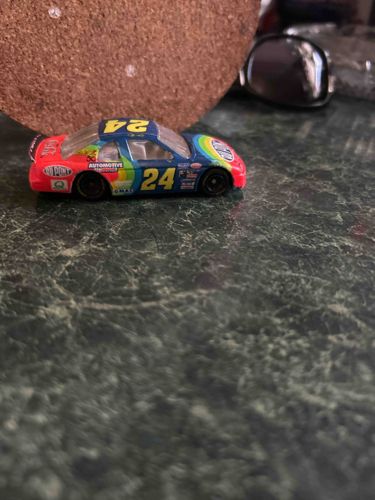
This is a miniature diecast replica of a NASCAR stock car, specifically representing the iconic 'Rainbow Warriors' paint scheme of Jeff Gordon's #24 car. The car features a vibrant and complex multi-color livery, predominantly blue on the top and front, transitioning into a rainbow spectrum (yellow, green, light blue, purple, red) across the sides and rear. The number '24' is prominently displayed in yellow on the hood and on both sides, outlined in black. Various sponsor decals are visible across the body, including 'DuPont Automotive' on the rear quarter panel, and other smaller logos on the front bumper and side panels, consistent with period race cars. The vehicle appears to be made of diecast metal for the body and plastic for the windows and interior components, typical of collectible toy automobiles. It has black plastic wheels and likely a plastic chassis. The overall scale seems to be around 1:64 or similar small collectible size. The item shows some signs of use, including minor scuffs or paint wear, particularly noticeable on the edges and corners, suggesting it has been handled or played with. The windows are clear, allowing a glimpse of a rudimentary interior. The design captures the aerodynamic shape of a stock car from the late 1990s to early 2000s, an era when Jeff Gordon was highly dominant in NASCAR. The craftsmanship is consistent with mass-produced diecast models, prioritizing recognizable detail and durability for play or display. There are no visible major damages like breaks or significant dents, and the colors remain relatively bright despite potential wear. The model likely dates to the period of the 'Rainbow Warriors' livery, which was primarily used from 1993 to 2000.
AI Appraisal Report
I have examined the provided image of the Jeff Gordon #24 'Rainbow Warriors' NASCAR Diecast Car. This is a miniature replica, likely of a 1:64 scale or similar small size, capturing the iconic livery used primarily between 1993 and 2000. Based on the visual evidence, the authenticity as a mass-produced diecast model of that era is highly probable, consistent with brands like Hot Wheels, Matchbox, or similar manufacturers.
The condition appears to be 'good' to 'very good' pre-owned condition, with visible minor scuffs and paint wear, particularly on edges and corners, suggesting it has been handled. Despite the wear, the colors remain vibrant, and there are no apparent major damages such as breaks or significant dents. The presence of 'DuPont Automotive' and other period-correct sponsor decals further supports its authenticity as a collectible from Gordon's dominant era.
Market conditions for common 1:64 scale NASCAR diecast cars, even from popular drivers like Jeff Gordon, are generally stable but not exceptionally high. This model benefits from the recognizable 'Rainbow Warriors' livery and the popularity of Gordon, which creates consistent demand among NASCAR enthusiasts and collectors of sports memorabilia. However, its mass-produced nature and the presence of minor wear prevent it from commanding premium prices. Rarity is low, as many such models were produced.
Factors impacting value positively include the iconic livery and driver. Negatively, the small scale, mass production, and visible wear limit its value. Higher values are typically seen for mint-condition, larger scale (e.g., 1:24 or 1:18) models, or rare production variations.
My assessment of authenticity is limited to visual examination. For full authentication and to ascertain specific manufacturer details, an in-person examination would be necessary to inspect manufacturer markings (typically on the base), material nuances, and precise scale. Provenance documentation, while unlikely for this type of item, would further solidify its history. No scientific testing is required for this common collectible.