These notes were written by the person who submitted this item. Appraiser.AI has not verified them, and the AI's identification and estimate may rely on them.
AI Estimated Value
Not an official valuation
$15-30
AI estimate as of July 24, 2025 · verify with a professional before acting
AI-Generated · Verify before acting
Everything on this page is generated by AI for informational purposes only. AI can make mistakes — the AI may misidentify items or misattribute them (artist, maker, brand, designer, origin, era). This is not an official valuation and should not be used for insurance, sale, tax, estate, legal, or lending purposes — or any decision requiring a certified appraisal. It is not an authoritative claim about any person, brand, or rights holder — do not share or rely on it as a factual statement about a third party. Always consult qualified professionals before making financial decisions.
This analysis also relies on unverified notes provided by the user, which may be incomplete or inaccurate and could affect the result.
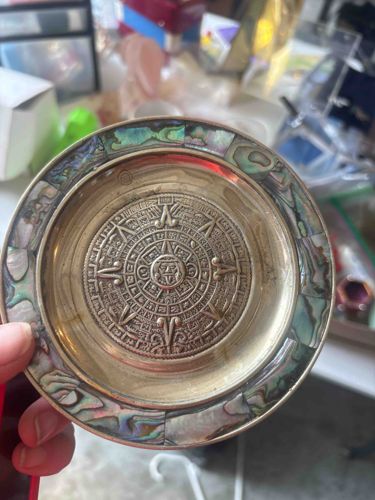
This item is a small, round decorative plate or coaster, approximately 4-5 inches in diameter, featuring a central design of what appears to be the Aztec Sun Stone (Piedra del Sol). The central motif is intricately embossed or debossed into a metallic material, likely brass, copper, or a base metal alloy, which exhibits a dulled, tarnished, or aged golden/bronze patina. The detailed relief work of the Sun Stone creates a textured surface in the center of the plate, showcasing various calendrical and mythological symbols. Surrounding this central medallion, forming the rim of the plate, is an inlaid border composed of multiple rectangular and irregularly shaped pieces of abalone shell, often mistakenly referred to as mother of pearl. These shell pieces display a vibrant, iridescent play of colors, including greens, blues, purples, and pinks, characteristic of abalone, giving the piece a distinct visual appeal. The shell segments are meticulously fitted together, forming a mosaic-like pattern. The overall construction suggests a combination of metalworking and inlay techniques. The metal rim encasing the abalone appears to be a uniform, perhaps rolled, edge. Signs of wear are visible, particularly in the form of surface scratches and nicks on the metallic surface, and a natural darkening of the metal due to oxidation, which contributes to its antique appearance. There are no clear manufacturer's marks or signatures visible from the provided image, making it difficult to ascertain specific origins or a precise manufacturing date; however, such items, often associated with Mexican craftsmanship, typically date from the mid-20th century onwards as tourist or decorative pieces. The craftsmanship, while not museum-grade, appears to be of good quality for a commercial or souvenir item, with the inlay work being relatively precise. The visible condition suggests it has been handled and used.
AI Appraisal Report
Upon examining the images of this decorative plate, my assessment is that it is a well-crafted souvenir item, likely of Mexican origin, dating from the mid to late 20th century. The central design is a representation of the Aztec Sun Stone, or Piedra del Sol, rendered in a base metal alloy, possibly brass or alpaca silver, which exhibits a natural, age-appropriate patina. The surrounding border features a mosaic of genuine abalone shell, not mother-of-pearl as noted by the owner; this distinction is important as abalone typically has a more vibrant and colorful iridescence. The overall condition is good, showing signs of normal wear such as surface scratches and tarnishing, which are expected for an object of this type and age.
In the current market, similar decorative metal and abalone inlay pieces from Mexico are quite common. They are popular tourist and decorative items rather than fine art or significant historical artifacts. Comparable items, such as small plates, coasters, or ashtrays with similar motifs and materials, frequently sell online and at flea markets. Demand is steady but generally limited to collectors of folk art or those seeking decorative pieces with a specific aesthetic. The lack of a maker's mark and its identity as a souvenir item are primary factors limiting its value. While visually appealing, it does not possess significant rarity. A definitive valuation is limited by the inability to conduct a physical inspection. In person, I would test the metal content, examine the quality of the inlay setting more closely, and search for any hidden maker's marks that could link it to a specific workshop, which might modestly increase its value. Without such information, it is appraised as a decorative collectible.