These notes were written by the person who submitted this item. Appraiser.AI has not verified them, and the AI's identification and estimate may rely on them.
AI Estimated Value
Not an official valuation
$450-650
AI estimate as of July 31, 2025 · verify with a professional before acting
AI-Generated · Verify before acting
Everything on this page is generated by AI for informational purposes only. AI can make mistakes — the AI may misidentify items or misattribute them (artist, maker, brand, designer, origin, era). This is not an official valuation and should not be used for insurance, sale, tax, estate, legal, or lending purposes — or any decision requiring a certified appraisal. It is not an authoritative claim about any person, brand, or rights holder — do not share or rely on it as a factual statement about a third party. Always consult qualified professionals before making financial decisions.
This analysis also relies on unverified notes provided by the user, which may be incomplete or inaccurate and could affect the result.
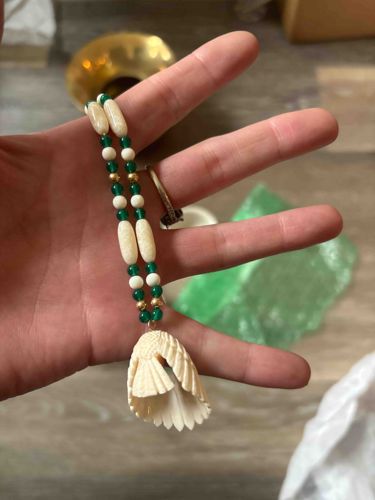
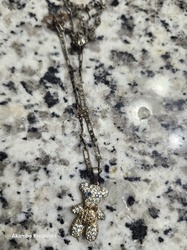
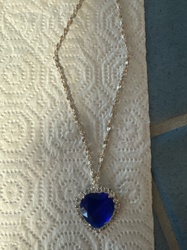
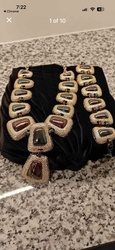
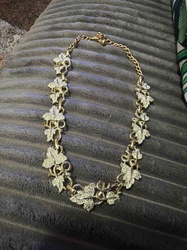
This item is a necklace, likely a pendant necklace, featuring elements crafted from what appears to be hand-carved ivory, combined with green and gold-toned beads. The primary material, described as 'ivory' and consistent with 'Alaskan Native Art hand carved ivory' context, suggests it could be fossilized walrus ivory or mammoth ivory, given current ivory trade regulations. The large, dominant pendant is hand-carved in a multi-layered, fan-like, or bell-like shape, possibly representing a stylized flower, a carved shell, or an abstract natural form. Its surface shows distinct ridges and curves, characteristic of intricate carving work. The color of the carved elements is a creamy, off-white, consistent with aged or unbleached ivory, exhibiting a subtle patina. The beads strung above the pendant consist of small, rounded, deep emerald green beads, interspersed with smaller, round, gold-colored beads and elongated, cylindrical ivory-colored beads. The arrangement creates a visually appealing contrast of colors and shapes. There are no visible chips, cracks, or significant damage to the carved ivory components or beads, suggesting good overall condition. The craftsmanship appears to be detailed and precise, indicative of skilled handwork. No specific maker's marks or signatures are discernible from the image. Based on the carving style and material, it likely dates from the 20th century, possibly mid to late, reflecting traditional indigenous artistry with a decorative or wearable purpose. The combination of natural materials with vibrant beads gives it a unique aesthetic.
AI Appraisal Report
Upon examining the provided image and description of this Alaskan Native pendant necklace, I find the piece to be a well-crafted example of indigenous artistry. The central pendant, described as hand-carved ivory, displays a sophisticated multi-layered, fan-like design. The craftsmanship appears precise and detailed, consistent with skilled work. Visually, the piece is in excellent condition, with no apparent chips, cracks, or damage to the carved elements or the accompanying green and gold-toned beads. The overall aesthetic is unique and appealing.
Market demand for authentic, well-made Alaskan Native art, particularly jewelry, remains steady. Pieces crafted from legally sourced ivory (such as fossilized walrus or mammoth ivory) are especially sought after. The value is significantly influenced by the artist's reputation, the quality of the carving, and the materials used. Without a signature, the primary value drivers are the piece's aesthetic merit and craftsmanship.
Comparable unsigned necklaces of similar complexity and material can range from $250 to over $700 in the current market. This piece's intricate pendant and excellent condition place it in the mid-to-upper end of that range. However, this appraisal is limited by the inability to conduct a physical examination. For full authentication, I would need to inspect the piece in person to confirm the material as genuine fossilized ivory versus bone or a synthetic alternative, and to search for any faint maker's marks. Scientific testing or provenance documentation would be required for definitive material verification, which would substantially impact its final value.