These notes were written by the person who submitted this item. Appraiser.AI has not verified them, and the AI's identification and estimate may rely on them.
AI Estimated Value
Not an official valuation
$150-250
AI estimate as of November 27, 2025 · verify with a professional before acting
AI-Generated · Verify before acting
Everything on this page is generated by AI for informational purposes only. AI can make mistakes — the AI may misidentify items or misattribute them (artist, maker, brand, designer, origin, era). This is not an official valuation and should not be used for insurance, sale, tax, estate, legal, or lending purposes — or any decision requiring a certified appraisal. It is not an authoritative claim about any person, brand, or rights holder — do not share or rely on it as a factual statement about a third party. Always consult qualified professionals before making financial decisions.
This analysis also relies on unverified notes provided by the user, which may be incomplete or inaccurate and could affect the result.
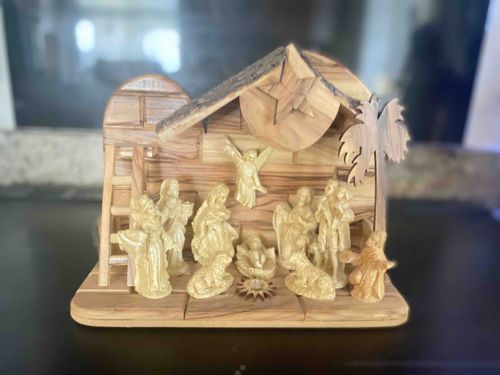
This is a meticulously hand-carved nativity scene crafted from olive wood, likely originating from the Holy Land, given the material commonly used for such devotional items. The scene is presented within a stable structure, also made of olive wood, featuring natural wood grain and variations in tone, from pale yellow to light brown. The stable roof is composed of two angled pieces with visible wood striations, and a prominent multi-pointed star, possibly representing the Star of Bethlehem, is carved into the upper structure. To the right of the stable, a flat, stylized olive tree is affixed, adding a touch of natural landscape. The figures within the stable include the Holy Family (Mary, Joseph, and the infant Jesus in a manger), an angel with outstretched wings positioned above, various shepherds or wise men, and at least two sheep. All figures exhibit a uniform, light-colored wood tone, with visible carving marks indicating artisanal production. The base of the nativity scene appears to be a solid piece of olive wood, providing a stable platform for the figures and the stable structure itself. A notable detail is a circular inlay on the base in front of the Christ child, which contains what is described as a 'relic' – likely Bethlehem earth, a common inclusion in nativity sets from the region, adding to its spiritual significance and authenticity. The item also integrates a music box functionality, which plays music, adding an auditory dimension to its purpose. The overall condition appears excellent, with no visible damage, cracks, or repairs. The natural patina of the olive wood is well-preserved, showcasing the beautiful grain. The craftsmanship suggests a folk art or traditional style, emphasizing skill in carving and assembly. The item's likely age is contemporary, possibly within the last few decades, given the fine detail and preservation.
AI Appraisal Report
Upon visual examination of this hand-carved olive wood nativity scene, I assess its condition to be excellent. The piece exhibits fine craftsmanship, consistent with artisanal work originating from the Holy Land, particularly Bethlehem. The olive wood displays a beautiful, well-preserved natural grain with no apparent cracks, chips, or repairs. The inclusion of a music box and a small inlay described as 'Bethlehem earth' significantly enhances its appeal as both a devotional and decorative item.
Market analysis indicates that similar contemporary olive wood nativities are widely available, which tempers the value despite the high quality of this specific example. The primary value drivers are the level of carving detail, the overall size, and the inclusion of special features. The music box functionality and the embedded relic are positive value factors that distinguish it from more basic sets. Demand for such items is steady, particularly during holiday seasons, but the market is not driven by rarity.
It is important to note the limitations of this appraisal, which is based solely on images. While the materials appear authentic, a physical inspection would be required to confirm the species of wood, verify the functionality of the music box, and more closely examine the 'relic' inlay. Full authentication of the relic's origin is impossible without provenance documentation from the manufacturer or seller. However, based on comparable sales of similar high-quality, feature-rich olive wood nativities from the region, the fair market value is estimated within the provided range.