These notes were written by the person who submitted this item. Appraiser.AI has not verified them, and the AI's identification and estimate may rely on them.
AI Estimated Value
Not an official valuation
$1,000-1,500
AI estimate as of June 28, 2025 · verify with a professional before acting
AI-Generated · Verify before acting
Everything on this page is generated by AI for informational purposes only. AI can make mistakes — the AI may misidentify items or misattribute them (artist, maker, brand, designer, origin, era). This is not an official valuation and should not be used for insurance, sale, tax, estate, legal, or lending purposes — or any decision requiring a certified appraisal. It is not an authoritative claim about any person, brand, or rights holder — do not share or rely on it as a factual statement about a third party. Always consult qualified professionals before making financial decisions.
This analysis also relies on unverified notes provided by the user, which may be incomplete or inaccurate and could affect the result.
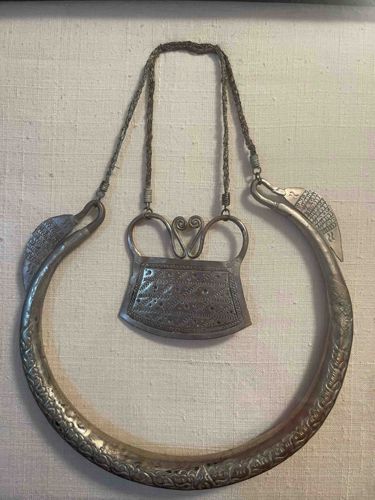
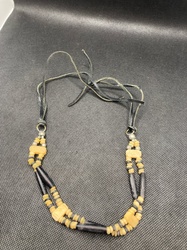
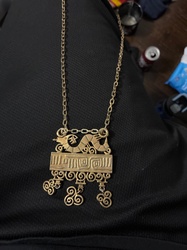
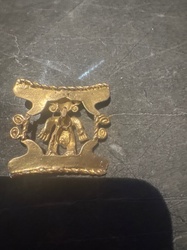
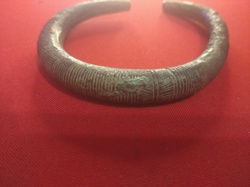
This is a striking 1950s Laotian silver marriage necklace, measuring approximately 7 inches across. The piece is crafted from substantial silver, exhibiting a deep, uncleaned patina that attests to its age and traditional handling, enhancing its authentic ethnographic appeal. The primary component is a robust, C-shaped tubular collar or torque, which tapers slightly towards its elaborately decorated, flattened terminals. The entire outer surface of this collar is meticulously embellished with intricate, repetitive patterns, likely executed through chasing or repoussé techniques, possibly depicting stylized floral motifs or geometric designs typical of traditional Laotian artistry. A key feature is the central shield-shaped pendant, also richly decorated with complementary patterns that echo those on the collar, showcasing exceptional consistency in design. The pendant is suspended by two sturdy silver rings, surmounted by a delicate, double-spiral or heart-shaped volute, which connects to a robust, hand-braided or woven silver chain. This chain, in turn, attaches to the stylized ends of the main collar, creating a unified and visually balanced structure. One terminal of the collar features a distinct, possibly zoomorphic or highly stylized mythological bird-like motif, adding a unique identifying characteristic. The craftsmanship throughout is of high quality, indicative of skilled traditional silversmithing, with no apparent major damage or repairs, although typical surface wear consistent with an object of this age and intended use is present. The overall presentation reflects its cultural significance as a marriage necklace.
AI Appraisal Report
Based on the detailed description provided for this 1950s Laotian Silver Marriage Necklace, I can offer a professional assessment. The piece appears to be in excellent condition for its age, reportedly showing "no apparent major damage or repairs," only "typical surface wear." The "deep, uncleaned patina" is a significant indicator of authenticity and age, highly valued by collectors as it reflects original traditional handling. The description of "substantial silver," "intricate, repetitive patterns," and "high quality craftsmanship" suggests a piece of considerable artistic and material merit. The unique "zoomophic or highly stylized mythological bird-like motif" on one terminal adds distinct cultural character.
The market for authentic ethnographic jewelry from Southeast Asia, particularly well-preserved pieces with cultural significance like marriage necklaces, remains stable. Demand exists among collectors of tribal arts and ethnic adornments. While not exceedingly rare, a piece with such craftsmanship and condition holds a strong place. Key value drivers are the quality of silverwork, its cultural context, and excellent preservation.
It is crucial to state that this appraisal is based solely on the provided textual description. A definitive authenticity verification and precise valuation require physical examination. In-person inspection would allow for accurate assessment of the silver's weight and purity, detailed examination of craftsmanship techniques (e.g., chasing vs. repoussé), confirmation of the natural patina, and verification of structural integrity. Without provenance documentation or scientific testing, absolute certainty regarding its 1950s dating and original cultural context remains an informed estimation based on consistent observable characteristics.