These notes were written by the person who submitted this item. Appraiser.AI has not verified them, and the AI's identification and estimate may rely on them.
AI Estimated Value
Not an official valuation
$450
AI estimate as of June 29, 2025 · verify with a professional before acting
AI-Generated · Verify before acting
Everything on this page is generated by AI for informational purposes only. AI can make mistakes — the AI may misidentify items or misattribute them (artist, maker, brand, designer, origin, era). This is not an official valuation and should not be used for insurance, sale, tax, estate, legal, or lending purposes — or any decision requiring a certified appraisal. It is not an authoritative claim about any person, brand, or rights holder — do not share or rely on it as a factual statement about a third party. Always consult qualified professionals before making financial decisions.
This analysis also relies on unverified notes provided by the user, which may be incomplete or inaccurate and could affect the result.
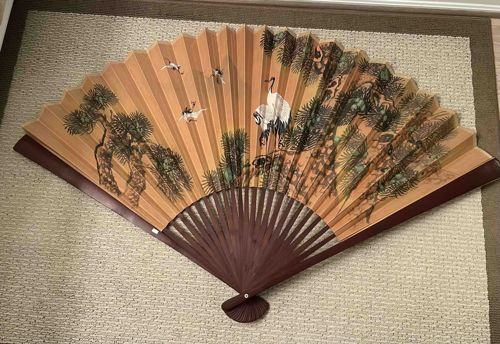
This is a substantial late-20th-century Asian wall fan, specifically identified as being from Shanghai and manufactured in 1984. It measures approximately 62.5 inches in width when fully open and stands about 37 inches tall, classifying it as a large-format decorative piece intended for display. The fan's structural components consist of numerous dark brown-stained wooden or bamboo ribs that emanate from a central pivot at the base, forming the classic pleated silhouette. These sturdy ribs support the main functional and artistic surface, which appears to be crafted from a robust paper or silk material, presented in a warm, light tan or beige color that serves as a neutral background for the artwork.
The fan's primary appeal lies in its hand-painted scene, executed in a traditional Asian style. The composition prominently features several evergreen trees, likely pine trees, characterized by their dark green, dense foliage and artistically rendered gnarled trunks. Amongst the trees and against the earthy-toned background, several white cranes are depicted. Some cranes are captured mid-flight, their wings extended gracefully, while at least two larger cranes are shown standing amidst the flora, portrayed with intricate details of their plumage and elongated forms. The painting employs a serene palette of greens, browns, blacks, and whites, creating a harmonious and balanced naturalistic scene that suggests tranquility and longevity, common themes in East Asian art.
While the image does not reveal specific manufacturer marks or artist signatures, the overall craftsmanship, particularly the detailed brushwork on the trees and cranes, indicates careful execution. The fan appears to be in good overall condition for its age, showing a natural patina consistent with a 1984 manufacture date. There are no visible signs of significant tears, major fading, or structural breaks, though minor creasing or subtle indentations on the pleated surface are to be expected and contribute to its authenticity as an aged textile or paper-based item. Its impressive size and dedicated artistry suggest it was produced as a high-quality decorative furnishing.
AI Appraisal Report
Based on my examination of the provided images and detailed description, this substantial 1984 Asian wall fan from Shanghai presents as a well-preserved decorative art piece. The overall condition appears very good for its age, consistent with a gently aged item from 1984, showing no visible significant tears, major fading, or structural breaks. The natural patina and minor expected creasing contribute to its authenticity as a vintage textile/paper item. The hand-painted pine and crane motif exhibits traditional aesthetics and appears competently executed, consistent with a quality decorative furnishing.
In the current market, large vintage Asian decorative items from the late 20th century, particularly those with auspicious motifs like cranes and pines, maintain a steady demand as accent pieces for various interiors. Comparables for such un-signed, mass-produced (though hand-finished) decorative fans typically fall into a moderate price bracket. While its impressive size and pleasing artwork contribute positively to its appeal, the absence of known artist signatures or specific manufacturer marks limits its valuation from a fine art perspective. It is considered a decorative item rather than a collectible rarity.
Several factors impact its value: the substantial size and appealing traditional aesthetics enhance its decorative utility. However, its relatively recent vintage (1984) and classification as a decorative commercial piece rather than an antique or unique artistic creation temper its market value.
It is crucial to note the limitations of remote appraisal. A definitive authenticity verification and condition assessment would require in-person examination to confirm material (e.g., silk versus paper), ascertain the precise nature of "hand-painting" (e.g., no stenciling, printed outlines), and identify any subtle, unphotographed damage or repairs. Provenance documentation, such as original sales receipts, would further enhance its historical and market value.