AI estimate as of August 10, 2025 · verify with a professional before acting
AI-Generated · Verify before acting
Everything on this page is generated by AI for informational purposes only. AI can make mistakes — the AI may misidentify items or misattribute them (artist, maker, brand, designer, origin, era). This is not an official valuation and should not be used for insurance, sale, tax, estate, legal, or lending purposes — or any decision requiring a certified appraisal. It is not an authoritative claim about any person, brand, or rights holder — do not share or rely on it as a factual statement about a third party. Always consult qualified professionals before making financial decisions.
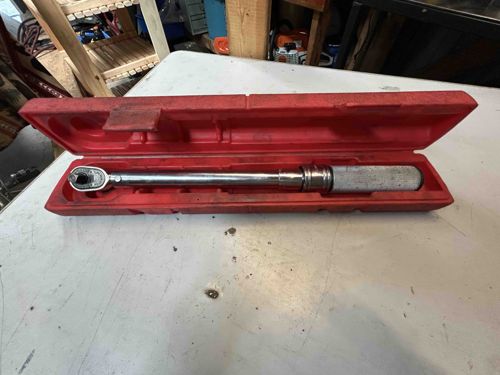
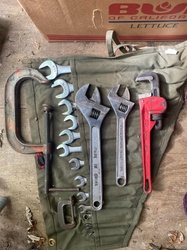
This item is a click-type torque wrench, housed in a molded red plastic carrying case. The wrench itself appears to be constructed primarily of polished steel or chrome-plated metal, displaying a bright, reflective finish typical of hand tools. It features a prominent knurled handle that appears to be made of aluminum or a similar light-colored metal, exhibiting significant signs of wear, discoloration, and grime, suggesting extensive previous use. The main shaft of the wrench is cylindrical and straight, leading to a square drive head on one end, which is in a ratcheting mechanism. The drive head size appears to be 1/2-inch, a common size for automotive or heavy-duty applications. Visible condition issues include the aforementioned heavy wear on the handle, as well as some scuffing and dirt within the red plastic case. The case itself is a clamshell design, precisely fitted to secure the wrench, with some internal depressions likely to cradle the tool. There are no immediate visible maker's marks or specific model numbers, but the overall design and construction are indicative of a professional-grade tool. The tool appears to be from a relatively modern era, likely late 20th to early 21st century, given its click-type mechanism and a case design. The craftsmanship appears robust, designed for durability and precision in its intended function.
AI Appraisal Report
Upon visual examination of the provided image, I assess this click-type torque wrench, housed in its original red molded plastic carrying case, to be a professional-grade tool. The wrench itself, primarily of polished steel or chrome-plated metal, exhibits a bright finish, which is typical for such implements. The prominent knurled aluminum handle shows significant wear, discoloration, and grime, indicating extensive prior use. This wear is a key factor in its condition assessment, placing it in fair to good used condition. The 1/2-inch square drive head and ratcheting mechanism are consistent with automotive or heavy-duty applications. No visible manufacturer's marks or model numbers are discernible from the image, which limits precise identification and authentication. The robust craftsmanship suggests durability and precision.
In terms of market conditions, similar-quality used click-type torque wrenches from reputable brands (Snap-on, Proto, SK, Craftsman Professional) typically fetch between $50 and $200, depending on condition, brand recognition, and included accessories. The lack of visible branding and the significant handle wear reduce its collectible appeal but not necessarily its utility. Demand for functional used tools remains consistent among hobbyists and professionals seeking economical alternatives. Rarity is low; these are mass-produced tools.
Factors significantly impacting value here are the unknown brand, the heavy wear on the handle, and the absence of any calibration certification (which is crucial for torque wrenches). The carrying case adds to its completeness but not significantly to its value given the overall condition.
Limitations in authenticity verification from images alone are substantial. I cannot definitively confirm its brand, true condition of internal mechanisms (ratchet, calibration), or if any internal components are damaged. For full authentication and accurate valuation, an in-person examination is critical to assess the functionality of the ratcheting head, the smoothness of adjustment, the presence of internal rust or defects, and, most importantly, to perform a calibration check. Provenance documentation, such as original purchase receipts or calibration certificates, would also be invaluable.