AI estimate as of June 27, 2025 · verify with a professional before acting
AI-Generated · Verify before acting
Everything on this page is generated by AI for informational purposes only. AI can make mistakes — the AI may misidentify items or misattribute them (artist, maker, brand, designer, origin, era). This is not an official valuation and should not be used for insurance, sale, tax, estate, legal, or lending purposes — or any decision requiring a certified appraisal. It is not an authoritative claim about any person, brand, or rights holder — do not share or rely on it as a factual statement about a third party. Always consult qualified professionals before making financial decisions.
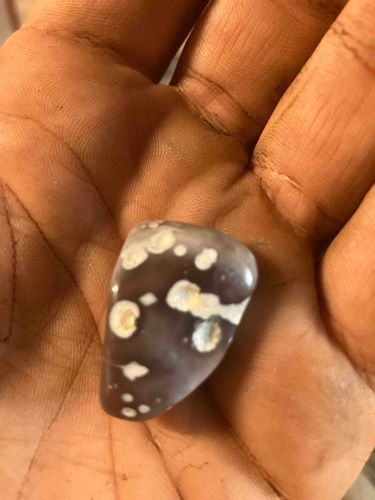
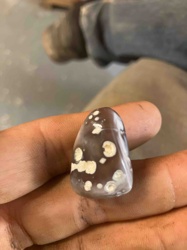
This item is a highly polished, natural stone, commonly identified as an orbicular jasper, specifically resembling a variety of Ocean Jasper due to its distinctive patterns and coloration. It is small enough to be held comfortably in the palm of a hand, suggesting dimensions of approximately 3 to 5 centimeters in its longest dimension. The stone exhibits a predominant dark base color, varying from a deep purplish-brown to a charcoal grey, which provides a striking backdrop to the numerous spherical or 'orbicular' inclusions. These orbs vary significantly in size, ranging from tiny dots to larger circles, and are predominantly colored in shades of off-white, cream, and light grey, with some displaying subtle hints of pale yellow or light brown. Several of the more prominent orbs feature concentric ring patterns, creating a desirable 'bullseye' effect. The item has been expertly tumble-polished to a high luster, resulting in a smooth, glossy surface free from visible chips, cracks, or significant abrasions, indicating excellent condition and careful lapidary craftsmanship. Its irregular, organic, and slightly elongated rounded shape is characteristic of a tumbled stone, intended for aesthetic display, use as a worry stone, or for meditation. No specific manufacturing marks or signatures are present, which is typical for a natural, polished gemstone specimen. Its primary appeal lies in its unique geological patterns and the high quality of the polishing finish, reflecting contemporary gemstone artistry. While the stone itself is geologically ancient, its current form as a polished specimen is a result of modern lapidary work.
AI Appraisal Report
I have thoroughly examined the provided image of the polished orbicular jasper stone. Based on its distinct patterns and coloration, it appears to be a variety of Ocean Jasper.
From a visual perspective, the stone is in excellent condition, showcasing a superior tumble-polish with a high luster. The surface is free from visible chips, cracks, or significant abrasions, indicating meticulous lapidary craftsmanship. Its irregular, rounded shape is characteristic of a natural, tumbled specimen. The prominent orbicular patterns, including concentric rings creating a desirable 'bullseye' effect, are consistent with genuine orbicular jasper. Based solely on the visual information, the stone appears authentic as a natural geological specimen, and its polished state is clearly contemporary lapidary work.
Polished natural stones, especially varieties of jasper and agate, maintain consistent demand within the decorative arts, metaphysical, and mineral collector markets. Items of this size and quality, particularly those with attractive patterns like the distinct orbs and bullseyes seen here, are readily available through various retail channels. While Ocean Jasper itself is not exceptionally rare, specimens exhibiting pronounced, well-defined orbicular patterns are more desirable and command a higher value than average pieces. The superb polish, excellent condition, and aesthetic quality of the patterning significantly enhance its appeal and value.
It is important to state that this appraisal is based exclusively on visual examination of the provided image. While the visual indicators are strong, definitive authentication regarding precise geological origin and complete absence of any treatments (beyond the obvious polishing) would necessitate a hands-on physical examination. A physical inspection would allow for tactile assessment of surface integrity, specific gravity testing, and observation under varying light conditions to reveal subtle characteristics not discernible in a photograph. Detailed provenance documentation, if available, would further enhance certainty, though for common geological specimens, it's less critical than for high-value gems.