AI estimate as of July 26, 2025 · verify with a professional before acting
AI-Generated · Verify before acting
Everything on this page is generated by AI for informational purposes only. AI can make mistakes — the AI may misidentify items or misattribute them (artist, maker, brand, designer, origin, era). This is not an official valuation and should not be used for insurance, sale, tax, estate, legal, or lending purposes — or any decision requiring a certified appraisal. It is not an authoritative claim about any person, brand, or rights holder — do not share or rely on it as a factual statement about a third party. Always consult qualified professionals before making financial decisions.
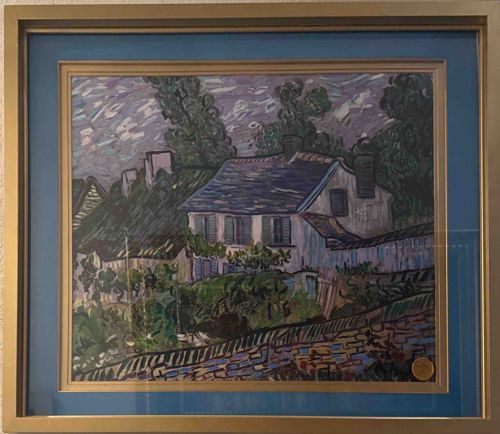
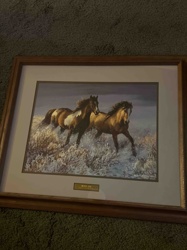
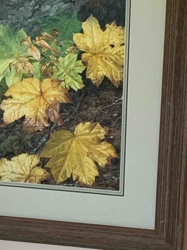
The item is a framed art print, likely a reproduction of Vincent van Gogh's 'Houses at Auvers' (or a similar landscape from his Auvers-sur-Oise period). The print is housed within a multi-layered frame structure. The outermost frame is a simple, rectangular profile made of a material that appears to be wood or a composite, finished in a metallic gold or brass tone. It shows a smooth, slightly reflective surface. Inside this outer frame, there is a wide, light blue matboard or liner, which effectively separates the print from the frame and adds depth. The blue mat has a smooth, matte finish. The print itself exhibits the characteristic impasto brushwork and vibrant color palette associated with Van Gogh, depicting a rural scene with houses nestled among trees, under a dynamic sky. The brushstrokes, though printed, convey a sense of texture and movement. The color tones are predominantly greens, blues, and grays, with touches of warmer earth tones in the foreground. In the lower right corner of the print, what appears to be a small, circular, metallic medallion or authentication seal is affixed, possibly indicating the origin of the print or a limited edition. The print is protected by a clear glazing, likely glass or acrylic, which exhibits some glare from ambient lighting, indicating it is reflective. There are no immediately visible signs of significant wear or damage to the frame or the print; the overall condition appears good, consistent with a display piece. The style period is Post-Impressionism, as it is a reproduction of a work by a master of this period, dating the original work to the late 19th century.
AI Appraisal Report
Upon visual examination of the provided image, I have assessed this framed print of what appears to be Vincent van Gogh's 'Houses at Auvers'. The item is a reproduction, not an original work. The overall condition appears to be good, with a well-constructed multi-layered frame consisting of a gold-toned outer frame and a light blue matboard, all protected by glazing. The print quality seems to capture the textural essence of Van Gogh's Post-Impressionist style.
The value of this piece is primarily decorative, as it is a mass-produced item. The market for high-quality reproductions of famous artworks is stable but vast, which keeps values modest. Comparable framed decorative prints of an established artist like Van Gogh typically sell in the secondary market for under $150. A key factor influencing value is the small metallic medallion in the lower right corner. If this seal indicates a limited edition from a reputable publisher (e.g., a museum or a fine art press), it could slightly elevate its value above a standard open-edition poster.
However, without a physical inspection, I cannot authenticate this seal, verify the print method (e.g., giclée vs. lithograph), or assess the materials' quality. The frame itself contributes to the value, but it appears to be a standard, commercially available style. For a definitive valuation, I would need to examine the piece in person to inspect the publisher's marks, the edition number (if any), and the overall craftsmanship of both the print and the frame.