AI estimate as of December 3, 2025 · verify with a professional before acting
AI-Generated · Verify before acting
Everything on this page is generated by AI for informational purposes only. AI can make mistakes — the AI may misidentify items or misattribute them (artist, maker, brand, designer, origin, era). This is not an official valuation and should not be used for insurance, sale, tax, estate, legal, or lending purposes — or any decision requiring a certified appraisal. It is not an authoritative claim about any person, brand, or rights holder — do not share or rely on it as a factual statement about a third party. Always consult qualified professionals before making financial decisions.
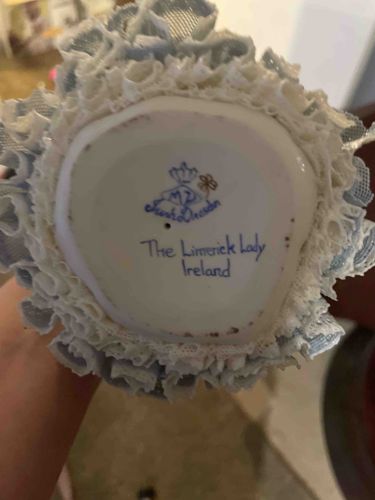
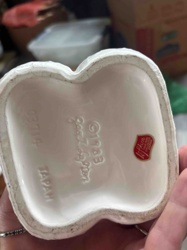
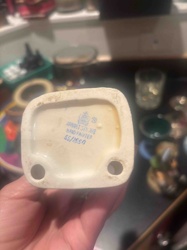
This image displays the underside base of a ceramic figurine, likely 'The Limerick Lady' as indicated by the prominent blue inscription. The item is characterized by its white glazed ceramic construction, which forms the core of the base. Around the perimeter of the circular base, there is an intricately ruffled trim, seemingly composed of white lace over a pale blue, possibly denim-like or plain woven fabric. The lace appears delicate and multi-layered, providing a voluminous and decorative edge. The central area of the base clearly exhibits a manufacturer's mark in blue underglaze. This mark shows a crown element, intertwined letters 'BP' or 'BB' (possibly indicating 'Belleek Pottery'), and the words 'Belleek Co. Fermanagh' and a small shamrock detail, suggesting an Irish origin. Below this mark, the inscription 'The Limerick Lady' and 'Ireland' are hand-painted in a consistent blue script. Although the figurine itself is not visible, the quality of the ceramic and the intricate fabric trim suggest a decorative collectible item. There are no significant visible condition issues such as chips, cracks, or repairs on the ceramic base, although some light discoloration or residue can be observed along the edge where the fabric trim meets the ceramic, potentially from age or handling. The fabric trim appears somewhat compressed or slightly worn in areas, consistent with typical age and handling for such a material. The craftsmanship, particularly the detailed lace work and the hand-painted inscriptions, points to a carefully produced item, likely from the late 20th century, given its style and the specific Belleek mark characteristics for that period. The combination of ceramic and fabric elements is a notable and a somewhat unique design choice for collectibles of this type.
AI Appraisal Report
Based on my visual examination of the provided image, this Irish Belleek 'The Limerick Lady' figurine base appears to be in good overall condition. The white glazed ceramic base shows no obvious chips, cracks, or repairs. I observe some minor discoloration or residue along the ceramic-fabric interface, which is consistent with age and handling. The fabric trim, a unique combination of ruffled white lace over a pale blue material, appears somewhat compressed in sections, but remains largely intact. The blue underglaze manufacturer's mark, featuring a crown, intertwined 'BP' or 'BB', 'Belleek Co. Fermanagh', and a shamrock, along with the hand-painted 'The Limerick Lady' and 'Ireland' inscription, all appear authentic for a Belleek piece from the late 20th century. The distinct factory mark aligns with Belleek's 7th or 8th period (green or black mark period), generally dating pieces from the late 1960s through the 1990s.
Market conditions for Belleek figurines, particularly those with fabric elements, indicate a moderate demand, but individual pieces rarely command exceptionally high prices unless they are part of a rare limited edition or a complete, pristine set. This item is only the base, which significantly impacts its value, as collectors typically seek complete figurines. Rarity is limited as 'The Limerick Lady' was a relatively common Belleek figurine. Factors impacting value negatively include the absence of the figurine itself and the delicate nature of the fabric trim which is prone to wear. The '7th mark' (green) or '8th mark' (black), if discernible in person, would help pinpoint the exact production era but would not drastically alter the appraisal without the figurine.
At this time, without the complete figurine, and based solely on the image of the base, I assess the appraisal value to be between $50 and $100. This is primarily a decorative display item for a collector who might have the figurine seeking to complete their piece or someone appreciating the craftsmanship of the base itself. Full authentication would benefit from in-person examination to confirm the mark's color, assess the fabric's integrity up close, and verify the ceramic's surface for any subtle repairs not visible in the photo. Provenance documentation, such as original sales receipts, could also provide additional authentication. Without the full figurine, the market for just the base is inherently limited.