AI estimate as of June 23, 2025 · verify with a professional before acting
AI-Generated · Verify before acting
Everything on this page is generated by AI for informational purposes only. AI can make mistakes — the AI may misidentify items or misattribute them (artist, maker, brand, designer, origin, era). This is not an official valuation and should not be used for insurance, sale, tax, estate, legal, or lending purposes — or any decision requiring a certified appraisal. It is not an authoritative claim about any person, brand, or rights holder — do not share or rely on it as a factual statement about a third party. Always consult qualified professionals before making financial decisions.
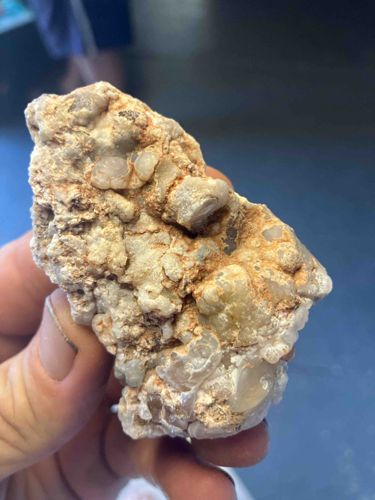
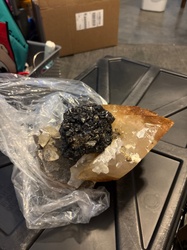
This appears to be a natural mineral specimen, possibly a type of geode or druzy formation, characterized by a rough, unrefined exterior hosting various crystalline growths. The specimen is predominantly an off-white to light beige color, with significant patches of reddish-brown coloration, suggesting the presence of iron oxides or other mineral staining within the host rock. Embedded within this matrix are numerous translucent to opaque crystal formations, varying in size and clarity. Some of these crystals exhibit a milky white or light gray hue, while others have a slightly yellowish or pale amber tint. Several prominent crystal clusters are visible, notably rounded or botryoidal in form, with some appearing more faceted or granular. The overall texture is highly irregular and porous, indicative of natural geological processes. There are no observable manufacturing marks, signatures, or stamps, consistent with a natural mineral formation. The condition appears to be natural, with no signs of recent damage, repairs, or significant wear beyond what would be expected from geological processes and handling. The estimated age is geological, given its natural formation. The quality indicators point to a specimen prized more for its natural formation and mineralogical interest rather than gem-quality clarity or specific lapidary preparation. It presents as an unpolished, natural example of mineral growth within a matrix.
AI Appraisal Report
Upon visual examination of the provided image, this natural mineral specimen appears to be a geode fragment, likely composed of quartz or chalcedony, characterized by its rough exterior and internal crystalline structures. The off-white to light beige matrix with reddish-brown staining is consistent with natural geological processes and iron oxide presence. The embedded translucent to opaque crystals, varying from milky white to pale amber, suggest druzy quartz or chalcedony. The irregular, porous texture and lack of manufacturing marks strongly support its authenticity as a natural formation. The condition appears stable and natural, without signs of recent damage or repair, beyond what is expected from its formation and unpolished state.Market conditions for such specimens vary. Similar natural geode fragments or druzy quartz specimens, particularly those unpolished and valued more for their scientific interest than aesthetic perfection, typically fall into a modest price range. Comparables would include raw mineral specimens sold by rock shops, online mineral dealers, and at gem and mineral shows. Demand for such unpolished natural pieces is generally moderate, driven by collectors, mineral enthusiasts, and those seeking decorative natural items. Its rarity is low to moderate; while each specimen is unique, druzy quartz and chalcedony geodes are not exceptionally rare.Factors impacting value include its unpolished state, which limits its appeal as a high-end decorative item, and the lack of exceptional color, clarity, or crystal size that would elevate its status to a gem-quality specimen. Its primary value lies in its natural formation and scientific interest.Limitations in authenticity verification from images alone are significant. While the visual indicators strongly point to a natural origin, definitive authentication would require in-person examination to assess specific mineral hardness, crystal structure under magnification, and density. Provenance documentation, though unlikely for a specimen of this nature, could offer additional support. Scientific testing, such as X-ray diffraction, would be needed for precise mineral identification (e.g., distinguishing quartz from chalcedony) and to confirm the absence of treatments or enhancements. Without physical inspection, I cannot confirm the exact mineralogy with 100% certainty.