AI estimate as of July 17, 2025 · verify with a professional before acting
AI-Generated · Verify before acting
Everything on this page is generated by AI for informational purposes only. AI can make mistakes — the AI may misidentify items or misattribute them (artist, maker, brand, designer, origin, era). This is not an official valuation and should not be used for insurance, sale, tax, estate, legal, or lending purposes — or any decision requiring a certified appraisal. It is not an authoritative claim about any person, brand, or rights holder — do not share or rely on it as a factual statement about a third party. Always consult qualified professionals before making financial decisions.
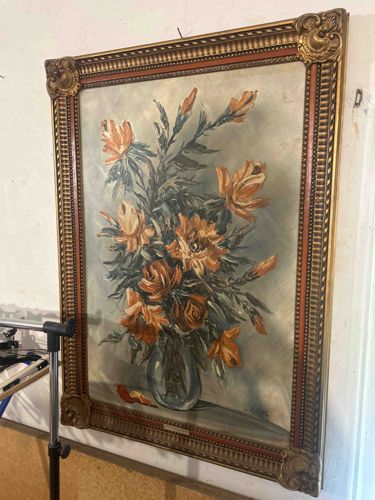
This item is a framed oil painting or print depicting a floral still life. The central subject is a bouquet of flowers, primarily rendered in shades of orange, yellow-orange, and muted reds, with prominent green foliage. The flowers appear to be a mix of roses and possibly lilies or gladioli, arranged in a clear glass vase which reflects some light. The background is a soft, muted light blue or grey, providing a subtle contrast to the warm tones of the flowers. The painting exhibits visible brushstrokes, suggesting it is either an original oil painting or a print with a textured finish designed to mimic an original. There are no discernible artist's signatures or maker's marks visible in the image. The colors appear somewhat subdued, which could be due to age, lighting, or the artistic style. One loose petal, rendered in similar orange hues, is depicted on the surface below the vase.
The artwork is encased in a substantial, ornate gilded frame. The frame features a multi-tiered design with intricate decorative elements, particularly on the outer edge and at the corners, where rococo-style scrolls and volutes are prominent. The inner band of the frame, directly bordering the artwork, is a deep reddish-brown, possibly mahogany or a similar wood, with a reeded or fluted texture. The outer edge of the frame has additional decorative beading and a raised, slightly more metallic-gold finish. The overall condition of the frame appears good with some minor wear consistent with age, particularly a slight patina on the gilding, but no apparent major damage. There is a hanging wire or string visible at the top, suggesting it is ready for display. The estimated age of the piece, based on the ornate frame style and color palette, would likely be mid-20th century, possibly dating back to the 1940s-1960s. The quality of craftsmanship for the frame appears to be good, indicating a commercially produced, but well-made, decorative frame typical of the period.
AI Appraisal Report
Based on my visual examination of the provided image, this floral still life painting in an ornate gilded frame presents as a decorative piece likely from the mid-20th century (1940s-1960s). The visible brushstrokes suggest it could be an original oil painting, though it is difficult to definitively rule out a textured print without in-person inspection. The absence of a visible artist's signature or maker's marks is common for commercially produced decorative art of this period. The overall condition appears good, with expected minor wear and patina on the gilded frame consistent with its age, but no apparent major damage.
In terms of market conditions, decorative floral still lifes from this era are generally abundant. The demand tends to be modest, driven more by aesthetic appeal for home decor than by art historical significance or rarity. Comparable sales for similar unsigned decorative oil paintings in ornate frames typically fall within a modest range. The primary value drivers here are the appealing subject matter and the substantial, well-preserved ornate frame, which adds significant aesthetic and perceived value.
It is crucial to note the limitations of remote appraisal. Without a physical examination, I cannot conclusively determine if this is an original oil painting or a finely textured print. Physical examination would allow for closer inspection of paint layers, canvas texture, and frame construction which could reveal further details. Provenance documentation, though unlikely for such a piece, would provide ownership history. Scientific testing, such as pigment analysis, would be necessary for absolute authentication of originality and age, if its value warranted such expense. However, based on the visual information, it appears to be a good quality decorative piece for its category.