AI estimate as of November 11, 2025 · verify with a professional before acting
AI-Generated · Verify before acting
Everything on this page is generated by AI for informational purposes only. AI can make mistakes — the AI may misidentify items or misattribute them (artist, maker, brand, designer, origin, era). This is not an official valuation and should not be used for insurance, sale, tax, estate, legal, or lending purposes — or any decision requiring a certified appraisal. It is not an authoritative claim about any person, brand, or rights holder — do not share or rely on it as a factual statement about a third party. Always consult qualified professionals before making financial decisions.
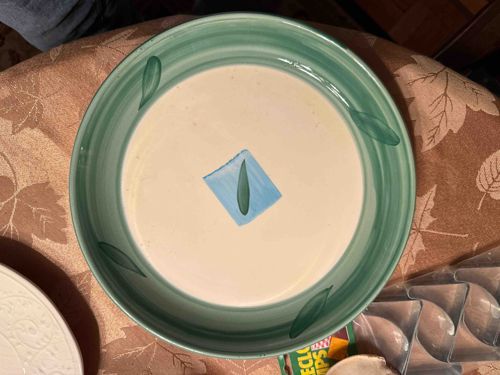
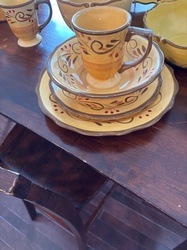
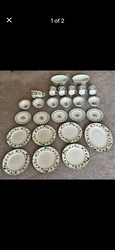
This is a hand-painted ceramic bowl, likely intended as a pasta bowl or a general serving bowl, featuring a distinctive rustic and casual aesthetic. The bowl has a circular shape with a shallow, wide basin and a gently sloped rim. The primary color of the interior base is a creamy off-white or very light beige. The rim and a wide band extending inwards from the rim are painted in a variegated medium to dark teal-green, with visible brushstrokes creating an uneven, organic finish. Scattered around this teal-green band are hand-painted leaf motifs in a slightly darker shade of green, adding to the naturalistic theme. In the center of the bowl's basin, there is a prominent, roughly diamond-shaped design in a lighter, pastel blue, accented with a darker green vertical stroke within it, possibly stylized as a leaf or a seed pod. The hand-painted nature is evident in the slightly irregular lines and color intensity, suggesting a lack of mass-produced precision and lending it a unique charm. The overall condition appears good with no obvious chips or cracks visible from the top-down view, though surface wear or crazing cannot be fully assessed without closer inspection. The style suggests a late 20th-century to early 21st-century production, leaning towards a Tuscan or Mediterranean-inspired design commonly found in casual dining ware. The quality seems decent for everyday use, with a focus on decorative appeal rather than fine porcelain craftsmanship. No specific maker's marks or signatures are visible in the provided image.
AI Appraisal Report
I have carefully examined the provided image of this hand-painted ceramic pasta/serving bowl. Based on my visual assessment, the bowl appears to be in good condition, with no visible chips, cracks, or significant damage. The hand-painted decoration, featuring a teal-green rim with leaf motifs and a central pastel blue design, suggests a rustic, casual aesthetic, likely inspired by Tuscan or Mediterranean styles. The irregular lines and varied color intensity are consistent with a hand-painted, artisan-style piece rather than machine-produced precision, contributing to its unique charm.
Authenticity, as it relates to being a genuine hand-painted ceramic item, appears strong based on the visual cues. However, without a physical examination, I cannot definitively assess the material quality, manufacturing techniques, or the presence of any maker's marks on the underside that might indicate a specific artist or studio. Surface wear, crazing, or subtle manufacturing flaws cannot be fully determined from an image alone.
In terms of market conditions, similar hand-painted ceramic serving bowls, particularly those with a casual or rustic appeal, are moderately available. They typically fall into the everyday dining ware category. Demand for such items is consistent but not high, primarily appealing to those seeking decorative utility pieces for their kitchen or dining room. Rarity is not a significant factor here; while unique in its hand-painted details, the overall form and style are common. Comparable sales for similar items in secondary markets or artisan craft sales usually range from $20 to $50, depending on size, artistic quality, and brand recognition.
The primary factors impacting its value are its decorative appeal, functional use, and apparent good condition. The lack of a discernible maker's mark prevents it from commanding a higher value associated with known artists or reputable studios. For full authentication and a more precise value, an in-person examination would be crucial to inspect the ceramic body for quality, assess weight and firing, identify any maker's marks, and evaluate the overall craftsmanship and integrity of the painting detail. Provenance documentation, though unlikely for an item of this type, would also add value.