AI estimate as of July 19, 2025 · verify with a professional before acting
AI-Generated · Verify before acting
Everything on this page is generated by AI for informational purposes only. AI can make mistakes — the AI may misidentify items or misattribute them (artist, maker, brand, designer, origin, era). This is not an official valuation and should not be used for insurance, sale, tax, estate, legal, or lending purposes — or any decision requiring a certified appraisal. It is not an authoritative claim about any person, brand, or rights holder — do not share or rely on it as a factual statement about a third party. Always consult qualified professionals before making financial decisions.
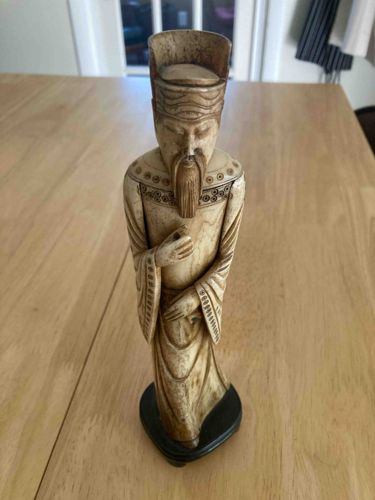
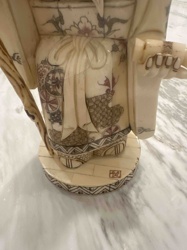
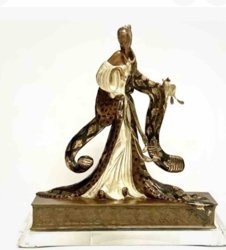
This item is a carved figurine depicting an elderly East Asian male figure, possibly a scholar, official, or deity, standing upright. The material appears to be natural bone or ivory, indicated by the creamy off-white color, fine grain, and subtle striations visible in some areas. The figure is meticulously carved with flowing robes and a distinctive headwear, characteristic of traditional East Asian attire. The face features finely detailed eyes, a prominent nose, and a long, narrow beard extending from the chin. The hands are positioned in front of the chest, holding what appears to be a small object, though its exact nature is not clear from the image.
Observable details include intricate patterns on the hat and along the upper chest/shoulder area of the robes, suggesting embroidered or embellished fabric. These patterns consist of small concentric circles and linear designs, executed with precision. The carving displays a high level of craftsmanship, particularly in the drapery of the robes, which shows deep folds and creases, giving a sense of movement and volume. The figure is mounted on a separate, dark-colored, possibly ebonized wood or resin base, which is heart-shaped or shield-shaped with a slightly raised edge, providing stability.
The overall condition appears good for its presumed age, showing a natural patination consistent with age and handling, evidenced by the slightly darkened and aged appearance of the material. There are no immediately obvious signs of significant damage such as chips, cracks, or repairs, though a detailed inspection would be needed to confirm. The style suggests it could be from the early to mid-20th century or possibly earlier, exhibiting traditional East Asian artistry. The craftsmanship indicates a skilled artisan, prioritizing detail and cultural authenticity.
AI Appraisal Report
Upon visual examination of the provided image, this carved figurine, depicting an East Asian scholar or official, displays characteristics consistent with natural bone or ivory. The creamy off-white color, subtle striations, and fine grain are indicative of such materials. The craftsmanship is notably high, particularly in the intricate detailing of the robes, facial features, and the distinct headwear. The intricate patterns of concentric circles and linear designs on the hat and robe suggest a meticulous hand and potentially a cultural significance. The figure's mounting on a heart-shaped, dark-colored base appears stable and functional.
The condition appears good for its presumed age, showing a natural patination consistent with aging and handling. I observe no obvious chips, cracks, or repairs from the image, suggesting careful preservation. The style strongly suggests an East Asian origin, likely early to mid-20th century, though dating older pieces from images alone is challenging. Market conditions for carved ivory/bone figures vary, influenced heavily by ethical considerations and legality surrounding the material. Pieces with demonstrable age and cultural authenticity, especially pre-ban, command higher values. Demand exists among collectors of East Asian art and decorative arts, but rarity is hard to assess without knowing the artist or specific origin.
Factors significantly impacting value include the material's precise identification (bone vs. ivory, and if ivory, its age relative to trade bans), confirmed provenance, and the artisan's identity. Without physical inspection, I cannot definitively ascertain the material composition (bone, ivory, or a composite resin) or confirm its age with absolute certainty. An in-person examination would allow for tactile assessment, detailed viewing under magnification for micro-crazing or tool marks, and weight assessment. Scientific testing like a hot point test or spectroscopic analysis would be invaluable for material verification. Provenance documentation, such as acquisition records or family history, would greatly enhance authenticity and value.