These notes were written by the person who submitted this item. Appraiser.AI has not verified them, and the AI's identification and estimate may rely on them.
AI Estimated Value
Not an official valuation
$800-1,200
AI estimate as of October 3, 2025 · verify with a professional before acting
AI-Generated · Verify before acting
Everything on this page is generated by AI for informational purposes only. AI can make mistakes — the AI may misidentify items or misattribute them (artist, maker, brand, designer, origin, era). This is not an official valuation and should not be used for insurance, sale, tax, estate, legal, or lending purposes — or any decision requiring a certified appraisal. It is not an authoritative claim about any person, brand, or rights holder — do not share or rely on it as a factual statement about a third party. Always consult qualified professionals before making financial decisions.
This analysis also relies on unverified notes provided by the user, which may be incomplete or inaccurate and could affect the result.
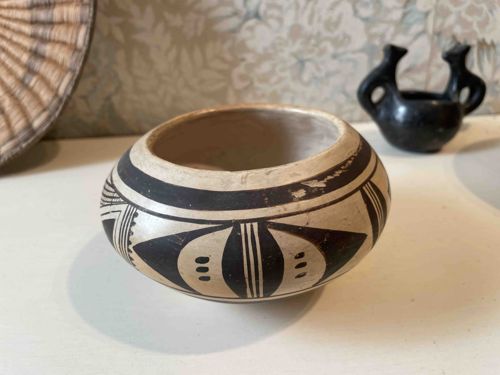
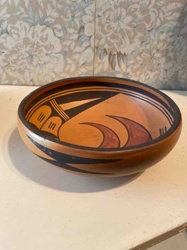
This is a hand-coiled ceramic bowl, identified as a Hopi Polychrome Bowl, likely dating from around 1925 based on the provided context. The bowl exhibits a squat, rounded form with a wide, slightly inverted mouth. The primary material is earthenware, characterized by a light cream to off-white slip applied to the exterior and interior rim. The decoration is executed in a dark brown to black pigment, likely organic paint, over the light slip. The design features geometric patterns, typical of Hopi pottery, creating distinct bands around the vessel.
Starting from the rim, there is a relatively thin band of solid dark pigment, followed by a wider band containing a repeated geometric motif. This motif includes bold, triangular or trapezoidal shapes filled with solid dark pigment, alternating with areas of the lighter ground color that feature fine parallel lines. Some of these lighter sections also contain small, vertically aligned dots or circles, suggesting stylized eyes or decorative elements. The base of the bowl appears to be undecorated, showing the natural clay body or a less prominent slip color. The quality of craftsmanship is evident in the symmetrical coiling and the relatively consistent application of the slip and paint, though some brushstrokes and minor inconsistencies in pigment density are discernible upon close inspection. The surface shows signs of age and wear, including some abrasions, minor chips or losses to the slip and paint, particularly along the rim and high points of the design. There is also a visible patina, indicating its age and handling over time. No distinct maker's marks or signatures are visible in the provided image. The overall aesthetic is traditional Native American pottery, specifically of the Southwestern United States, with a strong emphasis on indigenous designs and hand-made artistic expression.
AI Appraisal Report
I have carefully examined the provided image and description of this Hopi Polychrome Bowl, likely dating from around 1925. This hand-coiled ceramic piece exhibits a classic squat, rounded form with a distinctive wide, slightly inverted mouth. The light cream slip, characteristic earthenware body, and dark brown to black organic paint are consistent with Hopi pottery of the period. The geometric patterns, featuring bold triangular/trapezoidal motifs alternating with fine parallel lines and stylized dot elements, are well-executed and typical of traditional Southwestern Native American designs.
Condition-wise, the bowl shows expected signs of age and use. The visible abrasions, minor chips to the slip and paint (especially along the rim), and the developed patina are conducive to its stated age and suggest a well-cared-for but utilized ceremonial or domestic item. These minor imperfections are generally acceptable for antique pottery and contribute to its authenticity rather than detract significantly from its value, provided they are not extensive.
Based on current market conditions for antique Native American pottery, particularly Hopi pieces from this era, a bowl of this size, decorative quality, and condition is quite desirable. Comparables for well-documented early 20th-century Hopi Polychrome pottery of similar form and design typically range from 'mid-hundreds' to 'low thousands' depending on specific artist attribution (if known), condition, and provenance. While no artist's signature is visible, the quality suggests a skilled hand. Demand for authentic Native American artifacts remains strong, and pieces like this, with good age and traditional aesthetics, are consistently sought after by collectors.
It is crucial to state that my assessment is based solely on the provided image and description. Full authentication would require an in-person examination to verify clay type, slip application, paint composition, and construction methods. Furthermore, any available provenance documentation detailing its history of ownership would significantly enhance confidence in its authenticity and potentially its value. Scientific testing, such as thermoluminescence dating, could definitively confirm its age. Without these, while the visual evidence is compelling, absolute certainty regarding authenticity and specific attribution remains limited.