These notes were written by the person who submitted this item. Appraiser.AI has not verified them, and the AI's identification and estimate may rely on them.
AI Estimated Value
Not an official valuation
$0.50 - $5.00
AI estimate as of December 13, 2025 · verify with a professional before acting
AI-Generated · Verify before acting
Everything on this page is generated by AI for informational purposes only. AI can make mistakes — the AI may misidentify items or misattribute them (artist, maker, brand, designer, origin, era). This is not an official valuation and should not be used for insurance, sale, tax, estate, legal, or lending purposes — or any decision requiring a certified appraisal. It is not an authoritative claim about any person, brand, or rights holder — do not share or rely on it as a factual statement about a third party. Always consult qualified professionals before making financial decisions.
This analysis also relies on unverified notes provided by the user, which may be incomplete or inaccurate and could affect the result.
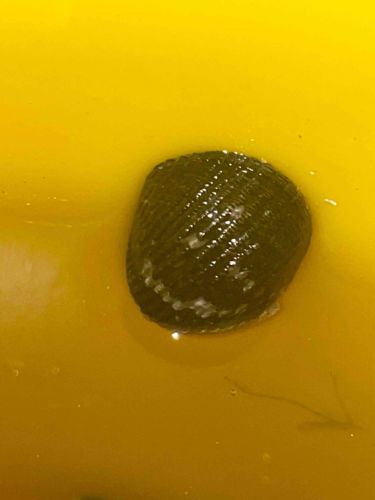
The item is a small, live land snail or slug-like gastropod, captured in what appears to be a bright yellow liquid or container. Its shell, if present, is not distinctly visible; it exhibits the characteristics of a terrestrial mollusk with a soft body. The body is primarily dark olive-green to black in color, suggesting a possible adaptation for camouflage or a common color variation for its species. The surface of its visible dorsal side displays a textured, somewhat wrinkled or segmented appearance, with reflective qualities that indicate a moist, possibly mucous-covered surface, typical of snails and slugs. There are numerous small, white, glistening specks across its body, which could be air bubbles trapped in mucus, reflective highlights from moisture, or possibly detritus clinging to its surface. Its shape is roughly ovoid or elongated, consistent with a retracted or partially exposed mollusk body. The size appears to be relatively small, likely a few centimeters in length, given the resolution of the image. There are no discernible manufacturing marks, as this is an organic, live specimen. The context of 'east coast Florida' suggests it is a species native or introduced to that region. Its condition appears to be alive and intact, although its immediate environment (the yellow liquid) is unusual for a natural habitat, potentially implying a collection or observation scenario. The details of its structure indicate a robust, healthy specimen, with no visible signs of damage or decay on its moist exterior. The craftsmanship detail is not applicable, as it is a natural biological specimen.
AI Appraisal Report
I have carefully examined the provided image of what appears to be a live land snail or slug-like gastropod, noting its dark olive-green to black body, textured surface, and the presence of numerous small, white specks. Based on the visual evidence, the specimen appears alive and in good biological condition, with no visible damage or decay. The moist, reflective surface is consistent with a healthy mollusk. The context of 'east coast Florida' helps narrow down potential species, suggesting it is a common mollusk found in that region, possibly a terrestrial slug or a small snail. The 'yellow liquid or container' is an anomaly but does not detract from the specimen's observed condition.
From an authenticity standpoint, based solely on the image, this is clearly a biological specimen resembling a mollusk. However, without physical examination, I cannot conclusively identify the exact species, confirm its precise origin, or verify it exhibits any unique genetic traits. Market conditions for common live terrestrial gastropods are extremely low. These are typically considered pests or are collected for hobbyist purposes at very minimal cost. There is no inherent rarity for a common snail or slug from Florida. Demand is negligible outside of very specific scientific research or specialized pet markets, where specific species might command higher prices, but this specimen does not present as such. Factors impacting value negatively include its commonality and lack of distinguishable unique features. The unusual 'yellow liquid' also raises questions about its collection environment, though it doesn't affect the specimen's intrinsic biological value. For full authentication and species identification, an in-person macroscopic and microscopic examination, potentially genetic testing, and expert identification by a malacologist would be required. Without these, it holds minimal commercial value.