These notes were written by the person who submitted this item. Appraiser.AI has not verified them, and the AI's identification and estimate may rely on them.
AI Estimated Value
Not an official valuation
$10 - $20
AI estimate as of November 16, 2025 · verify with a professional before acting
AI-Generated · Verify before acting
Everything on this page is generated by AI for informational purposes only. AI can make mistakes — the AI may misidentify items or misattribute them (artist, maker, brand, designer, origin, era). This is not an official valuation and should not be used for insurance, sale, tax, estate, legal, or lending purposes — or any decision requiring a certified appraisal. It is not an authoritative claim about any person, brand, or rights holder — do not share or rely on it as a factual statement about a third party. Always consult qualified professionals before making financial decisions.
This analysis also relies on unverified notes provided by the user, which may be incomplete or inaccurate and could affect the result.
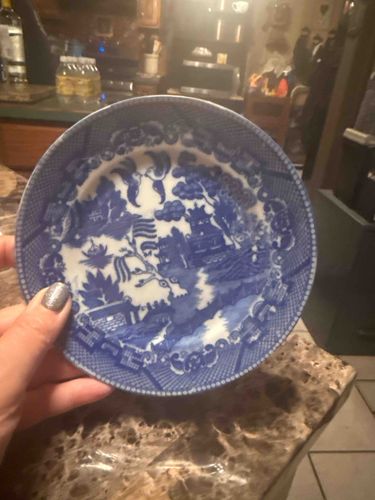
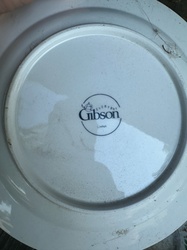
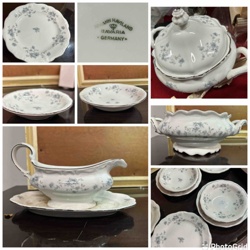
This is a small, round ceramic plate, most likely made of porcelain or earthenware, featuring the classic blue and white 'Willow Pattern' transferware design. The plate's primary colors are a deep cobalt blue against a stark white background. The central design depicts a picturesque Chinese landscape with pagodas, a bridge over water, a boat, birds, a fence, and stylized trees, characteristic of the iconic Willow Pattern. A decorative border, also in blue, frames the central motif with a repeating geometric and floral or cloud-like pattern. The blue color appears consistent and vibrant, indicating a well-preserved decal application. The plate's surface exhibits a glossy glaze, which contributes to its polished appearance. Visible details suggest a mass-produced item due to the transferware technique, which involves transferring an engraved pattern onto the ceramic surface. The rim appears slightly raised, forming a shallow bowl-like shape typical for a dessert or side plate. No significant chips, cracks, or repairs are immediately visible from the provided image, suggesting good overall condition. There might be minor surface wear consistent with age or use, but no major damage is apparent. The craftsmanship, though mass-produced, appears to be of standard quality for this type of dinnerware. Given the popular and enduring nature of the Willow Pattern, and the "made in japan plate" context, this plate likely dates from the mid-20th century onwards, when Japanese manufacturers widely produced similar blue and white ceramic ware for export.
AI Appraisal Report
I have examined the provided image and information regarding this small, round ceramic plate featuring the classic blue and white 'Willow Pattern' transferware design, noted as 'made in Japan'. Visually, the plate appears to be in good overall condition, with no immediate signs of chips, cracks, or significant repairs. The cobalt blue transferware design is vibrant and consistently applied, and the glossy glaze seems well-preserved. This suggests careful handling or limited use over its lifetime. As a mass-produced item utilizing the transferware technique, its authenticity as a genuine Willow Pattern piece of its type is not in question, but rather its origin and age. The 'made in Japan' context strongly places this piece in the mid-20th century or later, aligning with widespread Japanese production of such dinnerware for export. Comparably, similar Japanese-made Willow Pattern plates are readily available on the secondary market. Factors impacting value include its mass-produced nature, common design, and relatively modern origin. While the Willow Pattern is enduringly popular, the sheer volume of such pieces, particularly those from post-war Japanese production, limits rarity and significantly influences market value. Demand is consistent for everyday dinnerware, but not for high-value collecting. Given these considerations, I estimate a retail replacement value within the range of $10 to $20 for a single plate in this condition. It is important to note that without a physical examination, I cannot detect subtle surface wear, crazing, or potential maker's marks that might slightly adjust this valuation. Full authentication regarding specific production dates or factory origins beyond 'Japan' would require in-person inspection of any base marks.