AI estimate as of October 12, 2025 · verify with a professional before acting
AI-Generated · Verify before acting
Everything on this page is generated by AI for informational purposes only. AI can make mistakes — the AI may misidentify items or misattribute them (artist, maker, brand, designer, origin, era). This is not an official valuation and should not be used for insurance, sale, tax, estate, legal, or lending purposes — or any decision requiring a certified appraisal. It is not an authoritative claim about any person, brand, or rights holder — do not share or rely on it as a factual statement about a third party. Always consult qualified professionals before making financial decisions.
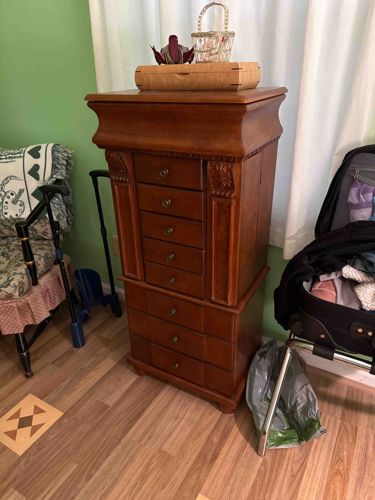
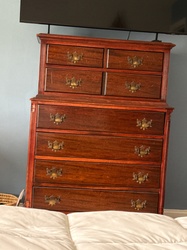
This is a tall, narrow wooden jewelry armoire, likely constructed from a hardwood such as cherry or mahogany given its rich reddish-brown hue and visible grain. The armoire features a traditional design with a substantial, overhanging top piece that has a gently curved or coved profile, suggesting a classic furniture style. The main body of the armoire is divided into two distinct sections. The upper section contains a series of smaller, uniform drawers, likely five or six in number, each fitted with a small, circular metal pull, possibly brass or a brass-finished alloy, indicating a detailed, functional design for organizing various types of jewelry. Flanking these drawers are decorative panels that appear to feature carved or embossed floral or scrollwork motifs, adding an element of ornate craftsmanship. The lower section consists of larger, wider drawers, typically for larger items or additional storage, also equipped with matching circular pulls. The overall construction suggests solid wood, though some panels might be veneer. The finish appears to be in good condition with a noticeable sheen, indicating regular care. There are no readily apparent significant damages, deep scratches, or repairs visible in the image. This piece is designed for functional storage and decorative appeal, characteristic of furniture from the mid-20th century to contemporary reproductions, aiming for a classic and elegant aesthetic. The quality indicators include the robust construction, detailed carvings, and consistent hardware, suggesting a well-made, durable item.
AI Appraisal Report
Based on my visual examination of the provided image, this Tall Wooden Jewelry Armoire appears to be in very good condition. The rich reddish-brown hue and visible grain suggest a hardwood construction, possibly cherry or mahogany, which contributes to its perceived quality. The traditional design, coved top, and consistent circular metal pulls all indicate a well-maintained piece. The decorative carved or embossed floral/scrollwork motifs add a touch of craftsmanship and elevate its aesthetic beyond purely utilitarian storage. The noticeable sheen suggests regular care, and I observe no significant visible damages, deep scratches, or repairs that would detract from its value.
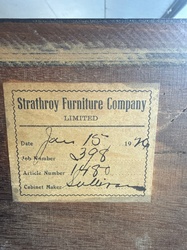
Authenticity of material (solid wood vs. veneer for certain panels) cannot be definitively confirmed from an image alone. An in-person inspection would allow me to assess the density, joinery, and specific wood species more accurately. Additionally, I cannot verify the material of the metal pulls (brass vs. brass-finished alloy) from the image. Provenance documentation, such as original sales receipts or manufacturer's branding, would be crucial for precise dating and identifying the maker, which significantly impacts value for antique or designer pieces. Without this, I am appraising it as a well-made, decorative and functional storage item.
Given its traditional style, which has a steady but not exceptionally high demand in today's market, and its good condition, I would place its value within the mid-range for similar functional, decorative furniture. While its robust construction and detailed carvings suggest a higher quality than mass-produced veneer pieces, it's not a rare antique or a designer collectible. The market for such pieces is generally stable, but not experiencing significant appreciation. Without definitive age or maker identification, it primarily holds value as a functional and attractive piece of home furnishing.