AI Appraisal Estimate

AI-generated estimates · not official valuations

From the user

What was submitted

Photo and notes provided by the user — not generated by AI

Submitted item photo
Submitted photo · May 19, 2026

User's notes

No additional notes provided.

AI analysis below

AI appraisal

AI analysis & estimate

AI-Generated · Verify before acting

Everything below is generated by AI for informational purposes only. AI can make mistakes — the AI may misidentify items or misattribute them (artist, maker, brand, designer, origin, era). This is not an official valuation and should not be used for insurance, sale, tax, estate, legal, or lending purposes — or any decision requiring a certified appraisal. It is not an authoritative claim about any person, brand, or rights holder — do not share or rely on it as a factual statement about a third party. Always consult qualified professionals before making financial decisions.

Read the full disclaimer

AI Identification

·Not independently authenticated·Verify before acting

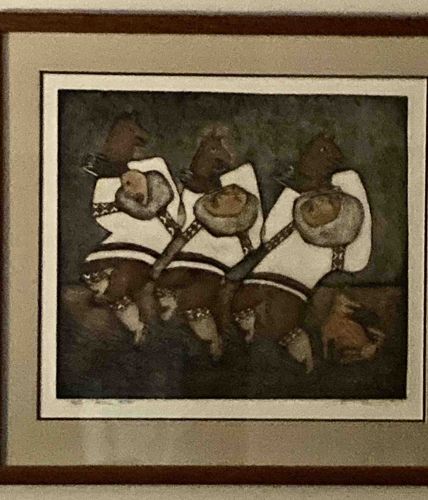
Inuit Art Stonecut or Lithograph Print of Mother Figures

Fine Art - Indigenous/Inuit Prints

AI Estimated Value

·Not an official valuation·Verify before acting

$1,200 - $1,800 USD

As of May 19, 2026

AI Item Analysis

·AI can make mistakes·Verify before acting
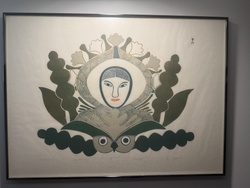
This artwork is a framed print, likely a stonecut or stencil lithograph, evocative of the mid-to-late 20th-century West Baffin Eskimo Co-operative or Cape Dorset style. It depicts three stylized figures, likely maternal in nature, wearing traditional Inuit 'amautis' (parkas) in a striking white silhouette against a dark, textured background composed of mottled grays and blacks. Each figure carries a small child or infant nestled within their hood. The subjects feature deep brown skin tones, rendered with a rich, earthy pigment that suggests the use of organic or stone-based inks. Significant attention is paid to the cultural patterns on the garments, showing geometric decorative bands at the waist and shoulders. The figures are grounded on a base of dark brown and black tones, with a smaller secondary animal figure or child visible at the bottom right. The print exhibits a soft, fibrous paper texture consistent with hand-pressed techniques. It is professionally matted with an off-white border and housed in a dark wooden frame. While signatures and edition numbers (likely written in pencil) are visible in the lower margin, their illegibility in the provided image prevents specific artist attribution, though the style bears a strong resemblance to established masters like Kenojuak Ashevak or Pitseolak Ashoona. The piece appears to be in good vintage condition with no visible foxing, tearing, or moisture damage, showing only minor light-aging to the mat board.
AI Appraisal Report

·AI can make mistakes·Verify before acting
Based on my visual examination, this print is a characteristic example of the Cape Dorset (Kinngait) mid-20th-century aesthetic. The composition, featuring central maternal silhouettes with infants in amautis, utilizes the classic stonecut or stencil technique on fibrous washi paper typical of the West Baffin Eskimo Co-operative. The saturation of the dark background against the stark white parkas indicates a well-preserved strike with minimal fading. The condition appears to be good; I observe no significant foxing or 'mat burn' from acidic materials, though the slight yellowing of the mat board suggests it should be replaced with archival-quality materials to prevent future degradation. The market for Cape Dorset prints remains robust, with high demand for maternal themes. Similar works from the 1960s and 70s by established artists often realize between $1,000 and $2,500 at auction depending on the specific artist and edition rarity. The valuation is currently tempered by the illegibility of the signatures in the provided documentation. If the pencil notations identify a high-market artist such as Pitseolak Ashoona or Pitaloosie Saila, the value could appreciate toward the higher end of the range. Important Limitation: This appraisal is based on photographic evidence only. For definitive authentication and a formal insurance valuation, an in-person inspection is required to verify the paper's watermark, examine the reverse for hinge-tape damage, and decipher the Syllabic signatures and Co-op blindstamp. Provenance, such as a gallery receipt from the 1970s or an original catalogue listing, would significantly solidify the attribution and market value.

Get your items appraised

Instant estimates of your treasures with AI-powered appraisals

Browse More Appraisals