AI Appraisal Estimate

AI-generated estimates · not official valuations

From the user

What was submitted

Photo and notes provided by the user — not generated by AI

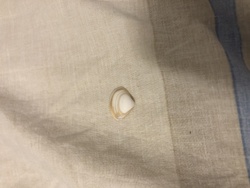
Submitted item photo
Submitted photo · June 6, 2026

User's notes

No additional notes provided.

AI analysis below

AI appraisal

AI analysis & estimate

AI-Generated · Verify before acting

Everything below is generated by AI for informational purposes only. AI can make mistakes — the AI may misidentify items or misattribute them (artist, maker, brand, designer, origin, era). This is not an official valuation and should not be used for insurance, sale, tax, estate, legal, or lending purposes — or any decision requiring a certified appraisal. It is not an authoritative claim about any person, brand, or rights holder — do not share or rely on it as a factual statement about a third party. Always consult qualified professionals before making financial decisions.

Read the full disclaimer

AI Identification

·Not independently authenticated·Verify before acting

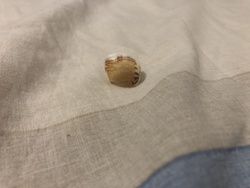
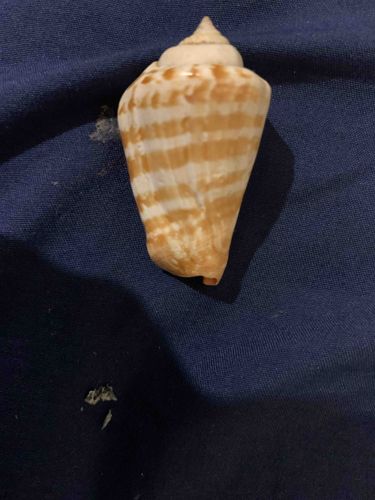
Conus Textile Seashell

Natural Specimen

AI Estimated Value

·Not an official valuation·Verify before acting

$10 - $25

As of June 6, 2026

AI Item Analysis

·AI can make mistakes·Verify before acting
The item is a Conus textile seashell, characterized by its distinctive conical shape and striking patterned exterior. Measuring approximately 2-3 inches in length, its base is broad, tapering gradually to a pointed apex. The shell's color palette primarily consists of cream or off-white horizontal bands alternating with warm, golden-brown or orange bands. These bands are uneven in width and exhibit a somewhat wavy, irregular pattern, which is typical of the species' 'tent' markings. The surface appears smooth, although texturing details might be more visible under different lighting or magnification. There are no obvious signs of significant damage such as large chips, cracks, or deep abrasions, suggesting it is in good, possibly 'collection-grade' condition, although the lighting makes it difficult to assess fine scratches or dulling of the natural sheen. The apex, or spire, is well-defined and sharp. The opening, or aperture, is not fully visible but typically runs along the length of one side. The shell exhibits the natural variations and irregularities one would expect from a marine gastropod, indicating it is an authentic specimen with natural organic growth. There are no discernible manufacturing marks or signatures, as it is a natural object. Its condition suggests it has been preserved reasonably well, likely collected post-mortem from a beach or shallow waters.
AI Appraisal Report

·AI can make mistakes·Verify before acting
I have examined the provided image of what appears to be a Conus textile seashell. Based on the visual evidence, the shell exhibits the characteristic conical shape and tent-like patterns typical of the species. Its stated size of 2-3 inches is common for this type. The color banding of cream/off-white and golden-brown/orange seems consistent with natural variations. I observe no obvious major damage such as large chips or cracks, suggesting it is in reasonably good condition. The general appearance indicates it is an authentic natural specimen, likely collected post-mortem. There are no signs of artificial alteration or manufacturing, which is expected for a natural object. Market conditions for common Conus textile shells are generally modest. While attractive, they are not considered rare on the global market, especially in this size range. Demand is primarily from amateur collectors, educational institutions, or hobbyists. Comparables for shells of this condition and size typically range from $5 to $30, depending on coloration vibrancy and specific patterning. This specimen, while nice, does not present exceptional features that would command a premium. Factors impacting value positively are its apparent good condition and characteristic patterning. Limitations in authentication from an image alone are significant. I cannot verify the exact surface texture, presence of fine scratches, dullness of natural sheen, or internal integrity without physical inspection. Provenance documentation (collection date, location, and method) would add significant value and authenticity assurance, especially for rare or provenance-dependent specimens, though less critical for this common species. Scientific testing would not typically be required for a shell of this type unless specific authenticity concerns arose (e.g., suspected fossilization or artificial coloring). Without physical examination, I cannot definitively rule out minor damage or repairs that are not visible in the provided image.

Get your items appraised

Instant estimates of your treasures with AI-powered appraisals

Browse More Appraisals