AI estimate as of August 31, 2025 · verify with a professional before acting
AI-Generated · Verify before acting
Everything on this page is generated by AI for informational purposes only. AI can make mistakes — the AI may misidentify items or misattribute them (artist, maker, brand, designer, origin, era). This is not an official valuation and should not be used for insurance, sale, tax, estate, legal, or lending purposes — or any decision requiring a certified appraisal. It is not an authoritative claim about any person, brand, or rights holder — do not share or rely on it as a factual statement about a third party. Always consult qualified professionals before making financial decisions.
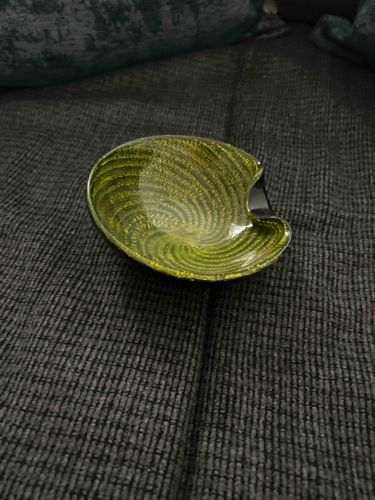
The item is a small, ornate glass bowl or dish, likely intended for decorative purposes or as a trinket dish. It exhibits a distinctive yellowish-green to lime green coloration, deeply infused with what appears to be gold, copper, or bronze aventurine inclusions, creating a shimmering, metallic effect. The glass is semi-transparent, allowing light to catch the internal speckles. Its form is asymmetrical, resembling an organic, flowing shape, possibly inspired by a leaf or an abstract shell, with undulating edges rather than a perfectly circular or oval perimeter. The most striking visual characteristic is the concentric spiral pattern that emanates from the center of the bowl, visible through the internal aventurine-infused layers. This swirling design is a key aesthetic feature, adding depth and visual interest. The construction suggests it is blown glass, possibly Murano glass due to the use of aventurine and the artistic, free-form shape, which aligns with Venetian glassmaking traditions. The craftmanship appears high quality, with smooth, polished edges and a consistent thickness of glass throughout, indicating skilled artisanry. There are no immediately visible cracks, chips, or significant wear on the surface, suggesting good preservation. One edge appears slightly more extended and possibly flattened or designed to serve as a handle or rest, adding to its unique profile. The estimated age for such a piece, given its style and material, would likely be mid-to-late 20th century, possibly dating from the 1950s to the 1980s.
AI Appraisal Report
Based on my visual examination of the provided image, this Aventurine Swirl Art Glass Bowl presents as a well-preserved decorative object. Its distinctive yellowish-green hue, robust aventurine inclusions, and organic, asymmetrical form with a concentric spiral pattern are notable. The craftsmanship appears competent, with no visible cracks, chips, or significant wear, suggesting excellent condition for its likely age. The stylistic elements, particularly the use of aventurine and free-form shaping, strongly evoke mid-to-late 20th-century glass production, possibly Murano, though definitive attribution without physical inspection is challenging.
Market conditions for decorative glass of this type are generally stable, with demand primarily from collectors of art glass and interior decorators seeking unique accents. While beautiful, pieces lacking a clear maker's mark or documented provenance usually fall into a broader 'art glass' category rather than fetching premium prices associated with renowned studios like Barovier & Toso or Seguso, even if stylistically similar. The spiraling aventurine is a desirable feature, adding to its aesthetic appeal and distinguishing it from more common pieces. Rarity is moderate; while not mass-produced, many such artistic pieces were made during the period.
Factors significantly impacting value include the lack of a definitive maker's mark or signature. Without this, its origin remains speculative. Full authentication would require in-person examination to assess glass characteristics, pontil mark, and internal structures more precisely. Provenance documentation, such as original sales receipts or exhibition history, would also significantly enhance authenticity and value. Scientific testing for glass composition could further narrow down its origin, but is rarely performed for items in this price range. Considering its condition, aesthetic appeal, and the limitations of image-based appraisal, I estimate its value to be in the range of $150-250.