AI Appraisal Estimate

AI-generated estimates · not official valuations

From the user

What was submitted

Photo and notes provided by the user — not generated by AI

Submitted item photo
Submitted photo · June 23, 2026

User's notes

No additional notes provided.

AI analysis below

AI appraisal

AI analysis & estimate

AI-Generated · Verify before acting

Everything below is generated by AI for informational purposes only. AI can make mistakes — the AI may misidentify items or misattribute them (artist, maker, brand, designer, origin, era). This is not an official valuation and should not be used for insurance, sale, tax, estate, legal, or lending purposes — or any decision requiring a certified appraisal. It is not an authoritative claim about any person, brand, or rights holder — do not share or rely on it as a factual statement about a third party. Always consult qualified professionals before making financial decisions.

Read the full disclaimer

AI Identification

·Not independently authenticated·Verify before acting

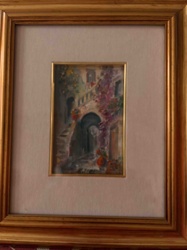
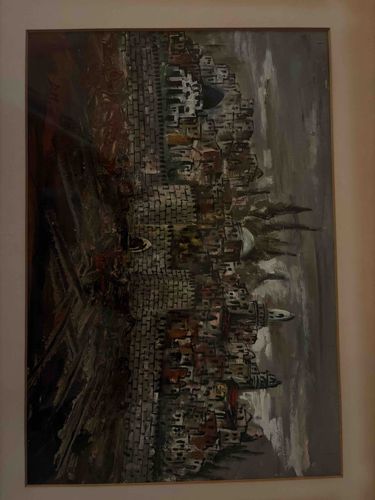
Mid-Century Abstract Cityscape Painting of Jerusalem

Fine Art - Paintings

AI Estimated Value

·Not an official valuation·Verify before acting

$400 - $700

As of June 23, 2026

AI Item Analysis

·AI can make mistakes·Verify before acting
This item is an original work of art, likely oil or acrylic on canvas or board, depicting an abstract, dense cityscape that appears to be the Old City of Jerusalem. The orientation is vertical, though presented horizontally in the image. The artist utilizes a restricted, earthy palette dominated by grays, blacks, and ochre, with frequent staccato accents of terracotta red and deep brown. The composition is built through heavily impastoed, blocky brushstrokes and palette knife work to suggest the stone architecture of a walled city, complete with domes, arched openings, and fortified walls. The style is characteristic of late mid-century expressionism, possibly dating from the 1960s or 1970s. Observable condition appears fair to good; there is some yellowing to the outer matte, indicating age and possible acidic material contact. The painting itself shows high-quality craftsmanship through its confident, textured application of paint which creates a three-dimensional topographic effect. While a signature is not immediately legible in this view, there is a red vertical inscription in the upper left corner that may serve as the artist's mark or date. The artwork is housed behind glass in a simple thin-profile frame, though the overall lighting of the photo makes it difficult to assess fine-scale cracking or surface craquelure. The piece captures the spiritual and historical density of Jerusalem through its layered, structural abstraction.


AI Appraisal Report

·AI can make mistakes·Verify before acting
I have virtually examined this mid-century abstract composition depicting the Old City of Jerusalem. The work exhibits a sophisticated mastery of the impasto technique, utilizing a palette knife to create a structural, architectural relief that is highly characteristic of the Israeli Expressionist movement of the 1960s and 1970s. The heavy application of paint suggests a confident hand and high artistic merit. Regarding condition, the primary concern is the visible yellowing and foxing on the surrounding matte, which suggests exposure to acidity and moisture; this may necessitate a professional cleaning and re-matting to prevent further degradation of the support. The red inscription in the upper left is a critical diagnostic feature, though without a definitive artist attribution, the value rests on its aesthetic quality as a 'School of' or 'Attributed to' piece. The market for mid-century Judaica remains stable, with demand driven by collectors of Brutalist and Expressionist architectural studies. Comparables for unsigned or illegibly signed works of this size and stylistic period typically realize mid-hundred figures at specialized auctions. However, the value is currently constrained by the lack of provenance and the obscured signature. Limitations: This appraisal is based solely on digital images. A physical inspection is required to check for paint flaking, substrate stability, and to identify the artist's mark under UV light or magnification. Full authentication would require non-destructive testing of the pigment binders and the removal of the frame to inspect the verso for gallery labels or stamps.

Related Tags

Explore similar items and categories

Get your items appraised

Instant estimates of your treasures with AI-powered appraisals

Browse More Appraisals