AI Appraisal Estimate

AI-generated estimates · not official valuations

From the user

What was submitted

Photo and notes provided by the user — not generated by AI

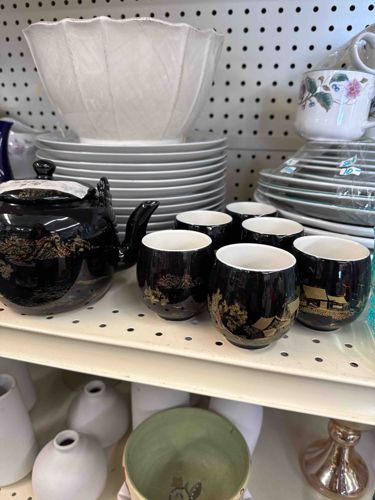
Submitted item photo
Submitted photo · June 8, 2026

User's notes

No additional notes provided.

AI analysis below

AI appraisal

AI analysis & estimate

AI-Generated · Verify before acting

Everything below is generated by AI for informational purposes only. AI can make mistakes — the AI may misidentify items or misattribute them (artist, maker, brand, designer, origin, era). This is not an official valuation and should not be used for insurance, sale, tax, estate, legal, or lending purposes — or any decision requiring a certified appraisal. It is not an authoritative claim about any person, brand, or rights holder — do not share or rely on it as a factual statement about a third party. Always consult qualified professionals before making financial decisions.

Read the full disclaimer

AI Identification

·Not independently authenticated·Verify before acting

Japanese Black and Gold Chinoiserie Ceramic Tea Set

Antique & Vintage Kitchenware/Collectible Ceramics

AI Estimated Value

·Not an official valuation·Verify before acting

$45.00 - $65.00

As of June 8, 2026

AI Item Analysis

·AI can make mistakes·Verify before acting
This is a vintage Japanese-style ceramic tea set consisting of one rounded teapot and six handleless tea cups (yunomi). The set is finished in a high-gloss black glaze adorned with intricate metallic gold Chinoiserie-style transfer or hand-painted motifs depicting traditional landscapes, including pagodas, trees, and mountains. The teapot features a squat, bulbous body with a short curved spout, a circular lid with a rounded finial, and a side handle. Each cup is cylindrical with a slight taper at the base and a contrasting stark white interior glaze. Based on the style and construction, the set likely dates from the mid-to-late 20th century. The craftsmanship shows mass-produced qualities common in mid-century souvenir or export ware, though the application of the gold detailing adds a layer of decorative refinement. Regarding condition, the black glaze appears largely intact with a high shine, though there is a white sticker residue or price tag on the lid of the teapot that needs careful removal. Some light surface shelf wear is visible on the foot rings, and there is potential for minor fading or thinning of the gold application consistent with age and previous use. No major cracks or chips are immediately visible from the frontal view, but the set would require a tactile inspection of the rims for small flea bites.
AI Appraisal Report

·AI can make mistakes·Verify before acting
I have completed a visual assessment of this mid-20th-century Japanese ceramic tea set. The set, featuring a teapot and six yunomi cups, showcases a high-gloss black glaze with gold-tone Chinoiserie landscapes. Based on the construction and the side-handle (kyusu) style, this appears to be a typical mid-century export or souvenir item, likely produced during the 'Occupied Japan' era or shortly thereafter (1950s-1960s). The application of the gold appears to be a transfer-print method rather than hand-painted, which is standard for mass-produced ceramics of this period. The condition is generally good; the glaze maintains its luster, though the sticker residue on the lid suggests it has been in a retail or secondary market environment. I observe minor shelf wear on the foot rings, which is expected. The primary value drivers for this set are its decorative appeal and completeness, as finding all six original cups intact is becoming less common. However, the market for mid-century Japanese lusterware is currently saturated, keeping prices modest. Comparables recently sold at auction and online marketplaces typically fetch between $40 and $70 depending on the presence of maker's marks, such as 'Kutani' or 'Made in Japan' stamps. Limitations of this appraisal include the inability to inspect for 'flea bite' chips along the rims or hairline fractures that are invisible in photographs. A full authentication would require an in-person tactile inspection and a loupe examination of the base markings to identify the specific kiln. To confirm the gold content (likely a low-karat liquid gold), acid testing or XRF scanning would be necessary, though rarely justified for items of this market profile.

Get your items appraised

Instant estimates of your treasures with AI-powered appraisals

Browse More Appraisals