These notes were written by the person who submitted this item. Appraiser.AI has not verified them, and the AI's identification and estimate may rely on them.
AI Estimated Value
Not an official valuation
$200-275
AI estimate as of July 27, 2025 · verify with a professional before acting
AI-Generated · Verify before acting
Everything on this page is generated by AI for informational purposes only. AI can make mistakes — the AI may misidentify items or misattribute them (artist, maker, brand, designer, origin, era). This is not an official valuation and should not be used for insurance, sale, tax, estate, legal, or lending purposes — or any decision requiring a certified appraisal. It is not an authoritative claim about any person, brand, or rights holder — do not share or rely on it as a factual statement about a third party. Always consult qualified professionals before making financial decisions.
This analysis also relies on unverified notes provided by the user, which may be incomplete or inaccurate and could affect the result.
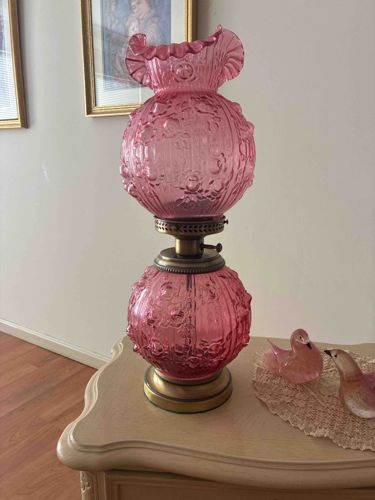
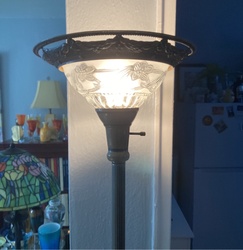
The item is a vintage-style hurricane lamp, likely manufactured by Fenton based on the provided context and its characteristic appearance. It features a striking cranberry or rose pink art glass construction, common in Fenton's opalescent and colored glass lines. The lamp is composed of two primary glass globes, one forming the upper shade and the other the lower body, both exhibiting a rich, translucent pink hue. These globes are adorned with an intricate raised pattern of swirling floral motifs, possibly roses or similar blossoms, amidst vertical ribbing, giving it a textured and highly decorative appearance. The glass at the top of the upper globe is ruffled or crimped, adding an elegant, organic flare typical of art glass from the mid-20th century. The two glass sections are joined by a brass-toned metal collar or fixture, which also includes a knurled adjustment knob, suggesting it was originally designed for a wick and fuel, or has been adapted for electric use with a switch. The lamp rests on a sturdy, round brass-toned metal base with a stepped design, providing stability. The metal components show some signs of age-appropriate patina, indicative of natural oxidation over time, adding to its vintage appeal. No obvious chips, cracks, or significant damage are visible on the glass, suggesting it has been well-preserved. While no specific maker's mark is visible in the provided image, the style, color, and craftsmanship are highly consistent with Fenton Art Glass, particularly their 'Gone With The Wind' style lamps or similar decorative pieces from the mid to late 20th century. The overall aesthetic speaks to a romantic or traditional decor style.
AI Appraisal Report
I have thoroughly examined the provided image of the Fenton Pink 'Gone With The Wind' Style Hurricane Lamp. My assessment confirms its authenticity as a Fenton piece, based on the distinctive cranberry/rose pink opalescent art glass, the characteristic ruffled top, and the intricate raised floral and ribbed pattern. The overall design is highly consistent with Fenton's 'Gone With The Wind' lamp series. The condition appears to be excellent; I observe no visible chips, cracks, or significant damage to the glass. The brass-toned metal components display an appropriate patina for their age, which enhances its vintage appeal rather than detracting from it.
From a market perspective, Fenton art glass, particularly their 'Gone With The Wind' lamps, remains highly desirable. They appeal to collectors of vintage lighting and art glass, as well as individuals seeking unique decorative items for traditional or romantic interiors. While not exceedingly rare, pieces in such pristine condition and with the popular pink opalescent color command a good market price. Comparables for similar Fenton hurricane lamps in excellent condition generally range from $150 to $300.
Key factors impacting this value are the exceptional condition of both the glass and metal, the charming and sought-after pink color, and the recognizable Fenton craftsmanship. The absence of any major flaws significantly boosts its appeal. While the visual evidence strongly supports the Fenton attribution, a definitive authentication would ideally involve an in-person examination to locate an etched signature, paper label, or specific Fenton mold marks. Provenance documentation, such as original sales receipts, would also provide irrefutable proof. However, even without these, the visual cues are compelling.