AI estimate as of October 18, 2025 · verify with a professional before acting
AI-Generated · Verify before acting
Everything on this page is generated by AI for informational purposes only. AI can make mistakes — the AI may misidentify items or misattribute them (artist, maker, brand, designer, origin, era). This is not an official valuation and should not be used for insurance, sale, tax, estate, legal, or lending purposes — or any decision requiring a certified appraisal. It is not an authoritative claim about any person, brand, or rights holder — do not share or rely on it as a factual statement about a third party. Always consult qualified professionals before making financial decisions.
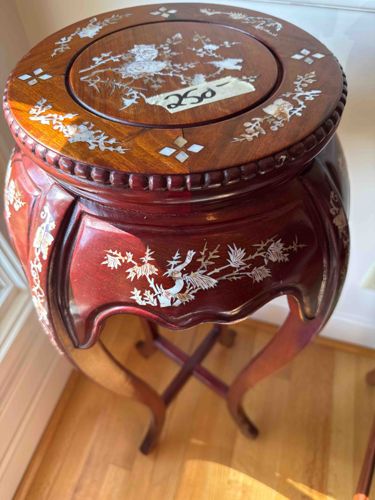
This item is a Chinese hardwood plant stand or small side table, characterized by its rich, reddish-brown lacquered finish and intricate mother-of-pearl inlay. The circular top features a central inlaid scene of birds amidst flowering branches, surrounded by a border of geometric rhombus-shaped inlays and smaller floral motifs. The rim of the table top has a finely carved, possibly reeded or fluted, edge, adding to its decorative appeal. The main body of the stand is cylindrical, gently curving inwards, and also adorned with extensive mother-of-pearl inlay depicting flora and avian subjects, consistent with traditional Asian artistry. The base transitions into four elegant, curved or cabriole-style legs that are joined by a stretcher in an 'X' configuration, providing stability. The wood appears to be a dense, fine-grained hardwood, common in Chinese furniture, possibly rosewood or a similar species, which has been polished to a high sheen. The visible condition suggests some surface wear consistent with age and use, including minor scratches or scuffs on the lacquered finish. There is a small white sticker on the tabletop with '250-' handwritten on it, likely indicating a price. The quality of the inlay work, with its delicate details and varying tones of mother-of-pearl, indicates skilled craftsmanship. The construction appears to be solid and well-executed, typical of traditional Chinese furniture, likely dating from the mid-20th century or earlier.
AI Appraisal Report
Based on my visual examination of the provided image, this Chinese hardwood inlaid plant stand or side table presents as a finely crafted piece. The rich reddish-brown lacquered finish, coupled with extensive mother-of-pearl inlay depicting birds and flora, is characteristic of traditional Chinese decorative arts. The circular top, cylindrical body, and cabriole-style legs joined by an 'X' stretcher demonstrate solid construction and aesthetic appeal. The quality of the inlay work, with its intricate details and varied shell tones, indicates skilled craftsmanship.
The item appears to be in good vintage condition, consistent with its likely mid-20th century or earlier origin. I observe minor surface wear, including some scratches or scuffs on the lacquered finish, which is expected for an item of this age that has seen use. The small '250-' sticker suggests a previous retail price, likely in a market familiar with such items.
Market demand for well-preserved, ornate Chinese hardwood furniture remains steady, particularly for pieces with elaborate inlay. Comparable items of this quality and period generally fetch in the mid to high hundreds. The rich detail and solid form contribute positively to its value. While not exceptionally rare, its aesthetic appeal and functional size make it desirable.
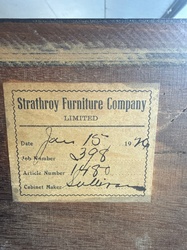
However, it is crucial to state the limitations of an image-only appraisal. Without physical inspection, I cannot definitively confirm the precise wood species (e.g., rosewood vs. a similar hardwood), the exact age beyond an approximate period, or the structural integrity of joints. An in-person examination would allow for a tactile assessment of the inlay quality, verification of the wood grain, and a thorough check for repairs or hidden damages. Provenance documentation, though unlikely for such a piece, would definitively confirm its age and origin. Scientific testing, such as carbon dating or wood analysis, would be required for absolute authentication of age and material, though this is rarely pursued for items in this value range. My appraisal assumes authenticity as a period Chinese decorative item based on visual cues.