AI estimate as of July 19, 2025 · verify with a professional before acting
AI-Generated · Verify before acting
Everything on this page is generated by AI for informational purposes only. AI can make mistakes — the AI may misidentify items or misattribute them (artist, maker, brand, designer, origin, era). This is not an official valuation and should not be used for insurance, sale, tax, estate, legal, or lending purposes — or any decision requiring a certified appraisal. It is not an authoritative claim about any person, brand, or rights holder — do not share or rely on it as a factual statement about a third party. Always consult qualified professionals before making financial decisions.
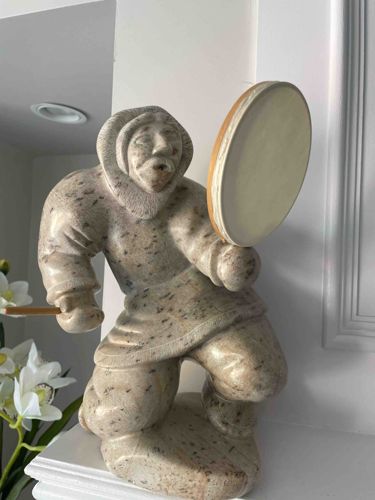
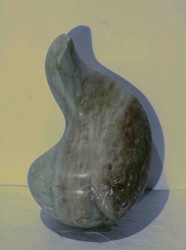
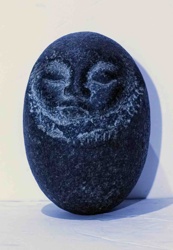
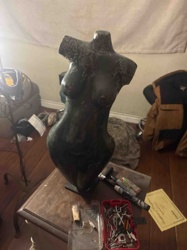
This is a substantial stone sculpture depicting a figure, likely a Northern Indigenous person, playing a hand drum. The sculpture is crafted from a light-colored, possibly granite or similar hard stone, characterized by a speckled or mottled appearance with dark mineral inclusions (black and reddish-brown flecks) scattered throughout a predominantly cream or light beige base. The figure is depicted in a dynamic pose, kneeling or crouching, with one leg bent at the knee and the other foot resting on the ground, suggesting movement or a performance. The individual is wearing what appears to be a parka with a prominent fur-lined hood, detailed with incised lines to suggest texture. The facial features are subtly rendered, showing a broad nose and open mouth, perhaps mid-chant or song. The figure holds a round, flat hand drum in one hand, which is rendered in the same speckled stone, though the drum's playable surface is smooth and contrastingly lighter, possibly indicating a stretched hide. In the other hand, the figure holds a drumstick, a simple rectangular stick. The craftsmanship is robust, with smooth, rounded contours indicating a well-finished surface, devoid of sharp edges or visible tool marks, suggesting meticulous carving and polishing. There are no noticeable condition issues such as chips, cracks, or repairs visible in the provided images, and the patina appears consistent with age. Maker's marks or signatures are not discernible from the given views. The style suggests a contemporary take on traditional Indigenous art, likely dating from the mid-to-late 20th century or early 21st century, reflecting cultural heritage and the art of performance.
AI Appraisal Report
I have examined the provided image of the stone sculpture depicting an Indigenous drummer. Based on this visual assessment, the sculpture appears to be in excellent condition, with no visible chips, cracks, or repairs. The consistent patina suggests good preservation. The carving exhibits robust craftsmanship with smooth, rounded contours, indicative of professional execution and polishing. Authenticity is difficult to definitively confirm from images alone; however, the style strongly aligns with contemporary Indigenous art, likely created in the mid-to-late 20th century or early 21st century. The material, described as a light-colored, speckled hard stone, possibly granite, is consistent with materials used in such works.
From a market perspective, sculptures of this size and quality, representing Indigenous cultural themes, generally see consistent demand. While not exceedingly rare, pieces by uncredited artists without strong provenance tend to fall into a broader decorative arts category. Comparable pieces, often by Inuit or other Northern Indigenous artists, sell in a range depending on material, artist recognition, and size. Factors significantly impacting value include the lack of a discernible maker's mark or signature, which prevents attributing it to a recognized artist, thus limiting its potential as a collectible fine art piece. The absence of provenance also impacts valuation.
To fully authenticate and maximize value, an in-person examination would be crucial to analyze the stone's precise composition and carving techniques for consistency with known artistic practices. Additionally, provenance documentation (e.g., origin of purchase, exhibition history) would be invaluable. Scientific testing might be considered for material identification if necessary, but is typically not required unless authenticity is strongly debated. Without further information, the value is based primarily on its intrinsic artistic and decorative merit.