AI estimate as of July 17, 2025 · verify with a professional before acting
AI-Generated · Verify before acting
Everything on this page is generated by AI for informational purposes only. AI can make mistakes — the AI may misidentify items or misattribute them (artist, maker, brand, designer, origin, era). This is not an official valuation and should not be used for insurance, sale, tax, estate, legal, or lending purposes — or any decision requiring a certified appraisal. It is not an authoritative claim about any person, brand, or rights holder — do not share or rely on it as a factual statement about a third party. Always consult qualified professionals before making financial decisions.
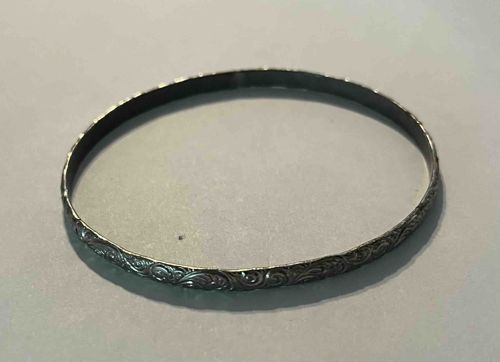
This is a vintage or antique bangle bracelet, likely crafted from sterling silver or a silver-plated base metal, due to its dark, somewhat tarnished appearance and the characteristic way the light reflects off its surface. The bracelet is a closed, circular band with a relatively thin profile. Its primary decorative feature is an intricate, continuous engraved or embossed pattern that runs around the entire outer circumference. This pattern appears to be a floral or foliate scrollwork design, characterized by elegant, swirling motifs that suggest a Victorian, Edwardian, or early 20th-century aesthetic. The raised areas of the pattern show a lighter, more polished silver tone, while the recessed areas retain a darker patina, highlighting the detail and providing depth to the design. There are no visible clasps or hinges, indicating it is a solid bangle designed to slip over the hand. The interior surface of the bracelet appears smooth and unadorned. There are no clear maker's marks or hallmarks visible in the provided image, which would typically be found on the interior surface. The craftsmanship appears to be of good quality, with the pattern evenly applied, suggesting either careful hand-engraving or a precise manufacturing process. The overall condition shows signs of age, including the dark oxidation consistent with silver tarnish, which contributes to its antique charm. There are no obvious dents, cracks, or significant abrasions visible, indicating relatively good preservation for its presumed age.
AI Appraisal Report
I have examined the image of this engraved bangle bracelet. Based on its appearance, I assess it to be a vintage or antique piece, likely from the late 19th to early 20th century, given the intricate floral/foliate scrollwork design which aligns with Victorian or Edwardian aesthetics. The darkening and how light reflects suggest it's sterling silver or a high-quality silver-plated base metal, with oxidation contributing to its antique charm. The craftsmanship appears good, with evenly applied engraving highlighting depth.
Its condition seems relatively good for its age, showing typical tarnish but no apparent dents, cracks, or significant abrasions. This preservation enhances its appeal.
Demand for well-preserved vintage silver jewelry, especially bangles with intricate designs, remains consistent among collectors and those seeking unique, historical fashion pieces. While not extremely rare, bangles in this condition and with such detailed engraving are less common than simpler designs.
Factors impacting value include the material (sterling silver would be significantly more valuable than plated), the age, the quality and intricacy of the engraving, and its overall condition. Market comparables for similar sterling silver bangles with intricate engraving typically range from $150 to $350. If it were confirmed to be silver-plated, the value would be considerably less, likely in the $50-$100 range due to its decorative appeal and age.
LIMITATIONS: It is crucial to note that authenticity verification for material is limited by image alone. Without physical examination, I cannot definitively confirm if it is sterling silver or silver-plated, which is the primary factor influencing its value. An in-person examination would allow for acid testing or closer inspection for hallmarks (often very faint) to confirm metal composition. Provenance documentation, if available, would also aid in historical verification.