AI estimate as of November 9, 2025 · verify with a professional before acting
AI-Generated · Verify before acting
Everything on this page is generated by AI for informational purposes only. AI can make mistakes — the AI may misidentify items or misattribute them (artist, maker, brand, designer, origin, era). This is not an official valuation and should not be used for insurance, sale, tax, estate, legal, or lending purposes — or any decision requiring a certified appraisal. It is not an authoritative claim about any person, brand, or rights holder — do not share or rely on it as a factual statement about a third party. Always consult qualified professionals before making financial decisions.
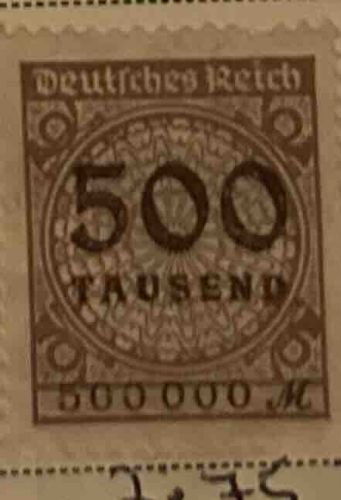
This item is a historical German postage stamp, issued during the period of hyperinflation in the Weimar Republic. The approximate size of the stamp is typical for postage stamps of the era, likely around 25mm to 30mm wide and tall. It is made of paper, characteristic of philatelic items. The dominant color visible is a muted brown or sepia tone, suggesting its age and the printing techniques of the time. The design is encased within a square border, with perforations visible along the edges, indicating it was likely torn from a sheet. At the top, the text 'Deutsches Reich' (German Empire) is prominently displayed in a Gothic or Fraktur-style typeface. The central feature is a large circular motif containing the numeral '500' in bold, dark digits. Below this, the word 'TAUSEND' (thousand) is written, also in bold. At the very bottom of the stamp, the full denomination '500 000 M' (500,000 Mark) is printed, signifying its extremely high face value due to the rampant inflation. The background within the circular design appears to have an intricate, almost filigree-like, pattern, possibly to deter counterfeiting. The overall condition appears to be fair to good, with some visible signs of age-related wear, such as slight discoloration and possibly minor creasing, though no major tears or significant damage are immediately apparent from the image. The perforations seem largely intact, which is a positive indicator for philatelic value. This stamp belongs to a series of high-denomination issues from the early 1920s, reflecting a specific and turbulent period in German economic history. The craftsmanship is typical of mass-produced postage stamps, focusing on clear legibility and security features.
AI Appraisal Report
I have examined the provided image of the German Hyperinflation Stamp - 500 Tausend (500,000) Mark. Based on the visual evidence, the stamp appears to be authentic, consistent with known issues from the Weimar Republic's hyperinflation period. The typeface, 'Deutsches Reich' text, circular '500 TAUSEND' motif, and '500 000 M' denomination align with historical examples. The perforations and paper quality also seem appropriate for the era.
The condition, as far as can be determined from an image, appears fair to good. I observe what seem to be minor discolorations and potential slight creasing, which are common for stamps of this age. The perforations largely intact is a positive sign. However, I cannot definitively assess foxing, thinning, repairs, or gum condition without physical inspection.
These hyperinflation stamps, while historically significant, are generally not rare. Millions were printed. The 500,000 Mark denomination is common. Market conditions show a steady, but not high, demand. Comparables for similar stamps in fair to good condition typically range from a few dollars to about fifteen dollars. Factors impacting value most significantly are cancellation (mint vs. used), gum condition, centering, and any significant flaws like tears or creases.
It is crucial to note that this appraisal is based solely on visual examination of an image. Full authentication would require an in-person examination to verify paper type, watermark (if any), gum condition, and to detect any repairs, alterations, or forgeries. While the visual indicators lean towards authenticity, only a physical inspection by a philatelic expert can provide a conclusive authenticity and condition assessment.