AI estimate as of October 4, 2025 · verify with a professional before acting
AI-Generated · Verify before acting
Everything on this page is generated by AI for informational purposes only. AI can make mistakes — the AI may misidentify items or misattribute them (artist, maker, brand, designer, origin, era). This is not an official valuation and should not be used for insurance, sale, tax, estate, legal, or lending purposes — or any decision requiring a certified appraisal. It is not an authoritative claim about any person, brand, or rights holder — do not share or rely on it as a factual statement about a third party. Always consult qualified professionals before making financial decisions.
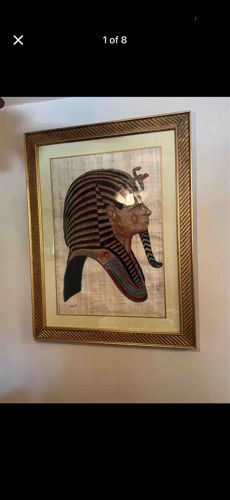
This item is a framed piece of artwork depicting the iconic mask of Pharaoh Tutankhamun, rendered on what appears to be a sheet of papyrus. The artwork is presented in profile, showcasing the pharaoh's distinctive nemes headdress with its blue and gold (or black and brown/gold in this rendering) stripes, and the cobra and vulture emblems at the brow. The details of the mask's face, including the eyes, nose, and chin beard, are visible, though some areas like the face and Uraeus appear to have some reflective material or gold leaf application, causing a glare in the image. The colors used are predominantly black, various shades of blue and red for the nemes and decorative collar, and a reddish-brown for the skin tone. The papyrus substrate itself exhibits the characteristic fibrous, somewhat uneven texture and light beige to off-white coloration typical of handmade papyrus. The artwork is housed within a gold-colored wooden frame with a subtle, possibly carved or molded, striped pattern along its inner and outer edges, giving it a somewhat ornate appearance. A light-colored matting, likely cream or off-white, separates the artwork from the frame, providing ample visual breathing room. The overall condition appears good, with no obvious signs of severe damage to the art or the frame, although specific wear and tear or manufacturing marks are not discernible from the provided image. The style suggests a reproduction or homage piece, likely dating from the mid to late 20th century or early 21st century, rather than an ancient artifact.
AI Appraisal Report
I have examined the provided image of the framed papyrus painting depicting Tutankhamun's Mask. Based on this visual examination, the artwork appears to be a modern reproduction or homage piece, likely dating from the mid to late 20th century or early 21st century. The papyrus substrate exhibits typical fibrous characteristics, and the color palette, featuring black, blue, red, and reddish-brown tones, is consistent with contemporary artistic interpretations of ancient Egyptian themes. The presence of reflective material, possibly gold leaf, adds a decorative element. The item is well-presented in a gold-colored wooden frame with a light-colored matting. The overall condition appears good, with no obvious damage visible from the image.
Authenticity: It is crucial to state that based on images alone, I cannot definitively verify the authenticity of the papyrus itself as an ancient artifact, nor confirm the artistic technique or materials used (e.g., whether it is genuine papyrus or a synthetic substitute, or if 'gold leaf' is actual gold). My assessment assumes it is a commercially produced decorative item. In-person examination would be required to verify the age and material composition of the papyrus, the type of paint used, and to detect any specific manufacturing marks or artist signatures. Provenance documentation, if available, would significantly aid in verification.
Market Conditions: Similar framed papyrus reproductions of Egyptian art are commonly found in gift shops, online marketplaces, and at tourist destinations. The demand is generally for decorative purposes rather than as fine art or historical artifacts. Rarity is low, as these items are produced in quantity. Factors impacting value include the quality of the artwork, the craftsmanship of the frame, and the condition. Without a known artist or unique historical significance, the value is primarily decorative.
Given these considerations, and assuming it is a decorative reproduction, I estimate the appraisal value to be between $50 and $150. This range accounts for the appealing presentation and decorative potential, acknowledging the limitations of image-based appraisal.