These notes were written by the person who submitted this item. Appraiser.AI has not verified them, and the AI's identification and estimate may rely on them.
AI Estimated Value
Not an official valuation
$1,500 - $2,500
AI estimate as of July 22, 2025 · verify with a professional before acting
AI-Generated · Verify before acting
Everything on this page is generated by AI for informational purposes only. AI can make mistakes — the AI may misidentify items or misattribute them (artist, maker, brand, designer, origin, era). This is not an official valuation and should not be used for insurance, sale, tax, estate, legal, or lending purposes — or any decision requiring a certified appraisal. It is not an authoritative claim about any person, brand, or rights holder — do not share or rely on it as a factual statement about a third party. Always consult qualified professionals before making financial decisions.
This analysis also relies on unverified notes provided by the user, which may be incomplete or inaccurate and could affect the result.
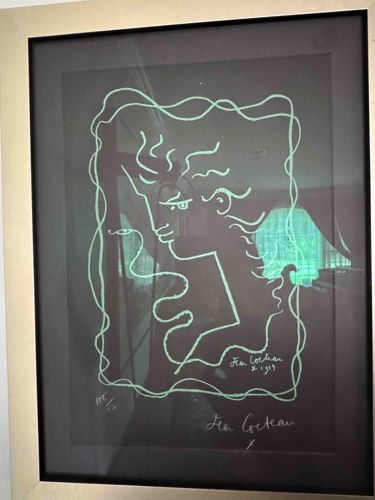
The item is a framed fine art print, likely a lithograph or serigraph, featuring a distinctive profile portrait rendered in a continuous line style. The artwork depicts a stylized head, possibly male, with flowing, curvilinear hair and a prominent, angular nose and chin. The eye is depicted simply as a circle with a dot, and the overall aesthetic is minimalist yet expressive.
The dominant colors of the print are a vibrant teal or light green for the line work set against a dark, possibly black or very dark grey, background. The lines of the artwork themselves are clean and consistent in thickness, suggesting a high-quality printing process. A decorative, wavy border encircles the central image, echoing the fluidity of the hair.
Several inscriptions are visible on the print. In the lower right quadrant, a signature appears to read "Jean Cocteau" followed by a distinct 'x' symbol and what looks like a date 'x 1919'. Below this, another larger signature reads "Jean Cocteau" with a similar 'x' below it, suggesting an autograph. In the lower-left corner, '119 / 199' is visible, indicating that this is a numbered print, likely from a limited edition of 199 copies, with this specific piece being number 119.
The print is housed behind glass in a simple, modern frame with a light, possibly natural wood or champagne-colored, finish and a dark inner mat or spacer. Reflections on the glass indicate it is a glazed frame. The print appears to be in good condition with no immediately visible tears, creases, or significant discoloration. The clarity of the lines and the rich background color suggest good preservation. The style is characteristic of Jean Cocteau's modernist line drawings and could date from the early to mid-20th century, consistent with the visible '1919' date, though it's important to verify if this date refers to the original drawing or the print's production.
AI Appraisal Report
Based on my visual examination of the provided image, this Jean Cocteau Profile Portrait Print appears to be in very good condition. The print exhibits crisp lines, vibrant color, and no apparent damage such as tears, creases, or significant discoloration. The framing seems appropriate and protective. The visible signatures, "Jean Cocteau" with a distinctive 'x' and the inscribed date 'x 1919', along with the edition numbering '119 / 199', align with typical practices for limited-edition fine art prints by established artists. The continuous line style is highly characteristic of Cocteau's work.
Market conditions for original Jean Cocteau prints, especially iconic portraits, are generally stable with consistent demand among collectors of modernist art. Limited editions like this one, particularly from an edition of 199, contribute to its rarity. The clear numbering '119 / 199' is a significant factor, confirming its status as a limited edition. The '1919' date, if it refers to the original artwork's creation, places it within Cocteau's active period, which benefits its historical and artistic value.
However, it is crucial to note the limitations of authenticating solely from images. While the visual cues are promising, full authentication would require an in-person examination to assess paper quality, printing technique, and the nature of the signatures (whether they are original pencil signatures or part of the print). Provenance documentation (e.g., certificates of authenticity, exhibition history, past ownership records) would also be vital. Scientific testing, such as ink analysis for the signatures, could provide definitive proof. Without these, the 'authenticity' from imagery alone is a strong visual indication, but not a definitive guarantee.