These notes were written by the person who submitted this item. Appraiser.AI has not verified them, and the AI's identification and estimate may rely on them.
AI Estimated Value
Not an official valuation
$250-450
AI estimate as of July 17, 2025 · verify with a professional before acting
AI-Generated · Verify before acting
Everything on this page is generated by AI for informational purposes only. AI can make mistakes — the AI may misidentify items or misattribute them (artist, maker, brand, designer, origin, era). This is not an official valuation and should not be used for insurance, sale, tax, estate, legal, or lending purposes — or any decision requiring a certified appraisal. It is not an authoritative claim about any person, brand, or rights holder — do not share or rely on it as a factual statement about a third party. Always consult qualified professionals before making financial decisions.
This analysis also relies on unverified notes provided by the user, which may be incomplete or inaccurate and could affect the result.
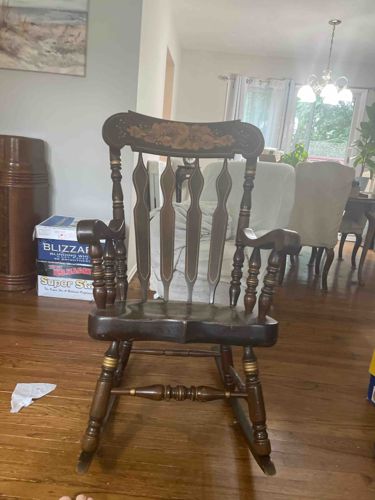
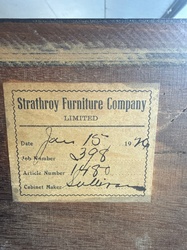
This is an antique wooden rocking chair, likely dating to the late 19th or early 20th century, possibly in the Boston rocker style or a variation thereof. The chair is constructed from stained hardwood, appearing to be a dark walnut or mahogany finish, with a slightly glossy patina. Its physical characteristics include a high, curved backrest with a decorative crest rail that features painted floral ornamentation in hues of gold, brown, and possibly faded red, indicative of hand-painted or stenciled embellishment. Below the crest rail, there are five elegantly curved and tapered spindles forming the back support. The armrests are stout and curved, supported by multiple turned spindles. The seat is solid wood, prominently shaped with a dished or saddle-like contour for comfort, showing signs of wear consistent with age and use, such as minor scratches and rubs on the finish. The legs are turned, with distinct decorative rings and some sections highlighted with what appears to be gold banding or paint, adding a touch of embellishment. The chair stands on two long, curved rocking runners, which also exhibit wear on their underside from contact with the floor. There are multiple turned stretchers connecting the legs for structural integrity. No explicit maker's marks or signatures are visible in the provided image. The overall construction appears solid with mortise and tenon joinery, suggesting good craftsmanship for its era. The condition appears to be good for its age, with an aged patina, but no significant structural damage or major repairs are discernible. The painted decoration on the crest rail shows some fading and minor wear, but remains largely intact, contributing to its aesthetic appeal. The dark wood finish enhances its antique charm.
AI Appraisal Report
Based on my visual examination of the image and the provided details, this antique wooden rocking chair, likely a Boston Rocker variant, presents in good condition for its presumed age, late 19th to early 20th century. The dark stained hardwood, possibly walnut or mahogany, exhibits an aged patina consistent with historical use, rather than significant damage. The hand-painted or stenciled floral ornamentation on the crest rail, while showing some fading and minor wear, remains a charming original feature, contributing to its decorative appeal. The turned spindles, dished seat, and curved rockers are characteristic of the style and suggest solid original craftsmanship. No structural damage or major repairs are discernible from the image, indicating it retains good integrity.
Establishing definitive authenticity and precise age from images alone is significantly limited. I cannot inspect joinery intimately, feel the wood, or search for faint maker's marks that might be obscured. A hands-on examination would allow for a thorough inspection of the construction methods, the type of wood, and the application of finishes, which could yield clues to its exact origin and manufacturing period. Provenance documentation, if available, would be invaluable for confirming its history and originality. Without these, I must make assumptions based on visual cues typical of the period.
In terms of market conditions, antique rocking chairs like this generally see moderate demand. While not exceedingly rare, a well-preserved example with attractive original decoration holds appeal for collectors of Americana and period furniture. Its decorative elements and functional appeal as a comfortable rocker contribute positively to its marketability. Comparable sales for similar chairs in good condition, often found in regional antique shops or online marketplaces specializing in period furniture, typically range in the low to mid-hundreds. Factors that would enhance value include verifiable provenance, a recognizable maker's mark (if applicable to this style), or exceptional artistic quality of the painted decoration. Conversely, extensive damage, poor repairs, or a very common form would diminish value. The absence of specific identifying marks or a unique design limits it from reaching higher values typically associated with designer pieces or those with significant historical provenance.
Given its aesthetic appeal, apparent good condition for its age, and general market demand for antique rocking chairs of this type, I assess its value.